Introduction
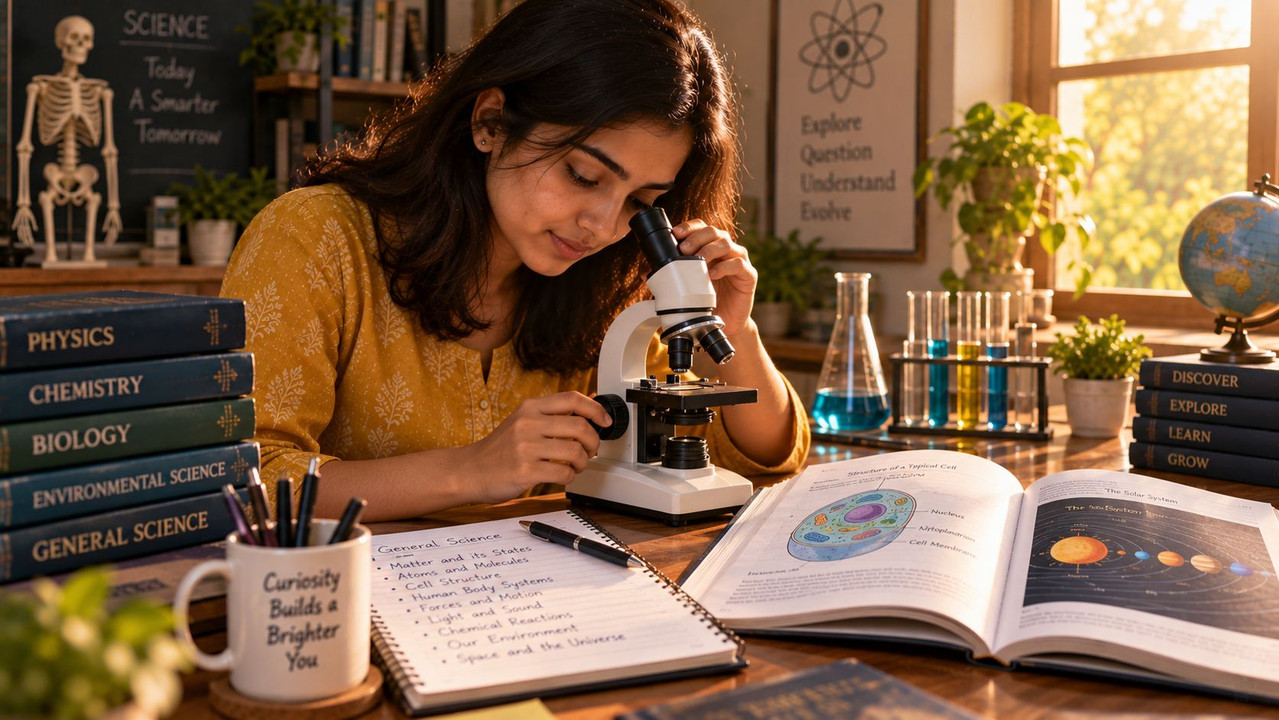
General Science is a core section across SSC, UPSC, Banking, Railway and State PSC exams, testing basic concepts from physics, chemistry and biology alongside human body facts, diseases, and space-related current developments. This guide compiles the most frequently tested science facts into one organised, exam-ready reference for quick revision.
Human Body
Key organ systems and facts:
| System/Organ | Key Fact |
|---|---|
| Heart | Four chambers (2 atria, 2 ventricles); pumps about 5 litres of blood per minute; average adult heart rate: 60-100 beats per minute |
| Blood | Made up of plasma, red blood cells (RBCs), white blood cells (WBCs), and platelets; RBCs carry oxygen via haemoglobin; WBCs fight infection |
| Blood groups | Classified into A, B, AB, and O types, based on the ABO system; Rh factor determines positive/negative; O-negative is the universal donor, AB-positive is the universal recipient |
| Kidneys | Two bean-shaped organs; filter blood and produce urine; basic functional unit is the nephron |
| Liver | Largest internal organ/gland; produces bile, detoxifies blood, stores glycogen |
| Brain | Divided into cerebrum (thinking, voluntary action), cerebellum (balance, coordination), and medulla oblongata (involuntary functions like breathing, heartbeat) |
| Skeletal system | Adult human body has 206 bones; the femur (thigh bone) is the longest and strongest bone; the stapes (in the ear) is the smallest bone |
| Skin | Largest organ of the human body by surface area and weight |
| Digestive system | Includes the mouth, oesophagus, stomach, small intestine, large intestine; small intestine is the longest part |
| Respiratory system | Lungs facilitate gas exchange; normal breathing rate: 12-16 breaths per minute at rest |
| Vitamins | Vitamin A (night vision, deficiency causes night blindness), Vitamin C (immunity, deficiency causes scurvy), Vitamin D (bone health, deficiency causes rickets), Vitamin K (blood clotting) |
Exam tip: The number of bones in the human body (206 in adults, 300 in infants — some fuse over time) and the largest/smallest organ facts are among the most repeated one-line factual questions in SSC and Railway exams.
Diseases & Vaccines
Classification of diseases:
- Communicable (Infectious) diseases: Caused by pathogens (bacteria, viruses, fungi, parasites) and can spread from person to person — e.g., tuberculosis, malaria, COVID-19
- Non-communicable diseases: Not caused by infectious agents and do not spread between people — e.g., diabetes, hypertension, cancer
Common diseases and their causative agents:
| Disease | Causative Agent | Type |
|---|---|---|
| Malaria | Plasmodium (protozoan parasite), spread by female Anopheles mosquito | Parasitic |
| Dengue | Dengue virus, spread by Aedes aegypti mosquito | Viral |
| Tuberculosis (TB) | Mycobacterium tuberculosis | Bacterial |
| Typhoid | Salmonella typhi bacteria | Bacterial |
| Cholera | Vibrio cholerae bacteria | Bacterial |
| Hepatitis | Hepatitis viruses (A, B, C, D, E) | Viral |
| Polio | Poliovirus | Viral |
| Rabies | Rabies virus (via animal bites) | Viral |
| Chickenpox | Varicella-zoster virus | Viral |
| AIDS | HIV (Human Immunodeficiency Virus) | Viral |
Key vaccines and their discoverers:
- Smallpox vaccine: Edward Jenner (1796) — the world's first vaccine
- Rabies vaccine: Louis Pasteur (1885)
- BCG (Bacillus Calmette-Guérin): Protects against tuberculosis
- Polio vaccine: Developed by Jonas Salk (inactivated, injectable) and Albert Sabin (oral, live attenuated)
- India's Universal Immunization Programme (UIP): Covers BCG, OPV (Oral Polio Vaccine), DPT, Measles, and Hepatitis B for children
Exam tip: Edward Jenner is frequently called the "Father of Immunology" for developing the smallpox vaccine, the world's first successful vaccine — a very commonly asked fact.
Physics Basics
Fundamental units and quantities:
- SI Units: Length (metre), Mass (kilogram), Time (second), Electric current (ampere), Temperature (kelvin), Amount of substance (mole), Luminous intensity (candela)
- Laws of Motion (Newton's three laws):
- First Law (Law of Inertia): An object remains at rest or in uniform motion unless acted upon by an external force
- Second Law: Force = mass × acceleration (F = ma)
- Third Law: Every action has an equal and opposite reaction
Key physics concepts frequently tested:
| Concept | Key Fact |
|---|---|
| Gravity | Discovered/formulated by Sir Isaac Newton; acceleration due to gravity on Earth ≈ 9.8 m/s² |
| Speed of light | Approximately 3 × 10⁸ m/s (fastest speed in the universe) |
| Sound | Cannot travel through a vacuum; travels faster in solids than in liquids or gases |
| Electricity | Ohm's Law: V = IR (Voltage = Current × Resistance) |
| Heat transfer | Occurs via conduction, convection, and radiation |
| Reflection & refraction | Reflection: bouncing back of light; Refraction: bending of light while passing between media of different densities |
| Nuclear physics | Radioactivity discovered by Henri Becquerel; further studied by Marie and Pierre Curie |
Chemistry Basics
Fundamental concepts:
- Atom: Smallest unit of matter; composed of protons (positive), neutrons (neutral), and electrons (negative)
- Periodic Table: Organises elements by atomic number; developed by Dmitri Mendeleev (1869) based on atomic mass, later refined by Henry Moseley based on atomic number
- States of matter: Solid, liquid, gas, and plasma (fourth state)
- pH Scale: Measures acidity/alkalinity from 0-14; pH 7 is neutral, below 7 is acidic, above 7 is alkaline/basic
Common elements/compounds frequently tested:
| Element/Compound | Chemical Formula/Symbol | Key Fact |
|---|---|---|
| Water | H₂O | Universal solvent |
| Table salt | NaCl (Sodium chloride) | Common household compound |
| Baking soda | NaHCO₃ (Sodium bicarbonate) | Used in cooking, antacids |
| Vinegar | Acetic acid (CH₃COOH) | Weak acid |
| Gold | Au | Most malleable and ductile metal |
| Diamond & Graphite | Both are allotropes of Carbon (C) | Same element, different structure |
| Mercury | Hg | Only metal that is liquid at room temperature |
| Oxygen | O₂ | Essential for respiration/combustion |
| Carbon dioxide | CO₂ | Product of respiration/combustion; greenhouse gas |
Biology
Cell — the basic unit of life:
- Discovered by: Robert Hooke (1665), who coined the term "cell" while observing cork under a microscope
- Cell Theory: Proposed by Matthias Schleiden and Theodor Schwann (1839); later refined by Rudolf Virchow ("all cells arise from pre-existing cells")
- Types of cells: Prokaryotic (no nucleus, e.g., bacteria) and Eukaryotic (nucleus present, e.g., plant and animal cells)
- Key cell organelles: Nucleus (controls cell activities, contains DNA), Mitochondria ("powerhouse of the cell," produces ATP/energy), Ribosomes (protein synthesis), Chloroplast (photosynthesis, found only in plant cells)
Genetics:
- Father of Genetics: Gregor Mendel, known for his pea plant experiments establishing the laws of inheritance
- DNA structure: Double helix, discovered by James Watson and Francis Crick (1953), based partly on X-ray data from Rosalind Franklin
Photosynthesis: The process by which green plants convert sunlight, water and carbon dioxide into glucose and oxygen, occurring in chloroplasts using chlorophyll
Classification of living organisms (Five Kingdom Classification by R.H. Whittaker, 1969): Monera, Protista, Fungi, Plantae, Animalia
Space & ISRO
- Indian Space Research Organisation (ISRO): India's national space agency, established on 15 August 1969; headquartered in Bengaluru, Karnataka
- Founder: Dr. Vikram Sarabhai, regarded as the "Father of the Indian Space Programme"
- Current ISRO Chairman: Dr. V. Narayanan (the 11th Chairman, in office since 14 January 2025), succeeding S. Somanath
- Major Indian space missions and milestones:
| Mission | Year | Significance |
|---|---|---|
| Aryabhata | 1975 | India's first satellite |
| Chandrayaan-1 | 2008 | India's first lunar mission; confirmed the presence of water molecules on the Moon |
| Mangalyaan (Mars Orbiter Mission) | 2013-14 | Made India the first country to reach Mars orbit in its very first attempt, and the cheapest Mars mission globally |
| Chandrayaan-2 | 2019 | Orbiter succeeded; lander (Vikram) crash-landed |
| Gaganyaan | Ongoing | India's first human spaceflight programme |
| Chandrayaan-3 | 2023 | Successful soft landing near the Moon's South Pole on 23 August 2023 (now celebrated as National Space Day); made India the 4th country to achieve a soft lunar landing and the first to land near the lunar South Pole |
| Aditya-L1 | 2023 | India's first solar observation mission, positioned at the L1 Lagrange point |
| NISAR | 2025 | Joint NASA-ISRO satellite for Earth observation |
Key space launch vehicles: PSLV (Polar Satellite Launch Vehicle) — India's workhorse rocket; GSLV (Geosynchronous Satellite Launch Vehicle) — for heavier payloads to geostationary orbit; LVM3 (formerly GSLV Mk III) — India's most powerful operational launch vehicle, used for Chandrayaan-3 and Gaganyaan missions
Exam tip: Mangalyaan's achievement of reaching Mars orbit on India's first attempt, and at a fraction of the cost of comparable international missions, remains one of the most frequently cited ISRO facts in exams.
Scientific Discoveries
| Discovery | Scientist | Field |
|---|---|---|
| Theory of Gravity | Sir Isaac Newton | Physics |
| Theory of Relativity | Albert Einstein | Physics |
| Laws of Motion | Sir Isaac Newton | Physics |
| Periodic Table | Dmitri Mendeleev | Chemistry |
| Radioactivity | Henri Becquerel; Marie & Pierre Curie | Physics/Chemistry |
| Vaccination (Smallpox) | Edward Jenner | Medicine |
| Theory of Evolution | Charles Darwin | Biology |
| Laws of Inheritance/Genetics | Gregor Mendel | Biology |
| Structure of DNA | James Watson & Francis Crick | Biology |
| Penicillin | Alexander Fleming | Medicine |
| X-rays | Wilhelm Röntgen | Physics |
| Telephone | Alexander Graham Bell | Technology |
| Electric bulb | Thomas Edison | Technology |
| Cell | Robert Hooke | Biology |
| Blood circulation | William Harvey | Medicine |
How Exams Test This Topic — Question Patterns to Watch
- Discoverer-to-discovery matching: One of the most common formats across SSC and Railway exams — always pair a scientist's name with their field and discovery.
- Disease-to-causative agent matching: Frequently tested, especially distinguishing bacterial (TB, typhoid, cholera) from viral (dengue, polio, hepatitis) diseases.
- Vitamin deficiency diseases: A recurring exam favourite — Vitamin A deficiency causes night blindness, Vitamin C deficiency causes scurvy, Vitamin D deficiency causes rickets.
- Number/unit facts: The number of bones (206), SI units, and speed of light are frequently tested as standalone one-line facts.
- Recent ISRO missions: Given the pace of India's space programme, always verify the latest mission names and outcomes (Chandrayaan-3, Aditya-L1, Gaganyaan progress, NISAR) close to your exam date, since this overlaps heavily with current affairs.
Frequently Asked Questions
Q1. How many bones are present in an adult human body?
An adult human body has 206 bones, while an infant is born with approximately 300 bones, many of which fuse together as the body grows. This is one of the most frequently repeated standalone factual questions in the General Science section of SSC and Railway exams.
Q2. What is the difference between communicable and non-communicable diseases?
Communicable diseases are caused by pathogens like bacteria, viruses, fungi or parasites and can spread from person to person, such as tuberculosis, malaria and dengue, while non-communicable diseases are not caused by infectious agents and do not spread between people, such as diabetes and hypertension. This distinction is frequently tested alongside questions on specific disease-causing agents.
Q3. Who is regarded as the Father of the Indian Space Programme, and who is the current ISRO Chairman?
Dr. Vikram Sarabhai is regarded as the Father of the Indian Space Programme, having played a key role in establishing the Indian Space Research Organisation (ISRO) in 1969. The current ISRO Chairman is Dr. V. Narayanan, who took charge as the 11th Chairman on 14 January 2025, succeeding S. Somanath.
Q4. What is the significance of Chandrayaan-3's landing site, and why is 23 August celebrated as National Space Day?
Chandrayaan-3 successfully soft-landed near the Moon's South Pole on 23 August 2023, making India the fourth country to achieve a soft lunar landing and the first country to land specifically near the lunar South Pole, a region of significant scientific interest due to suspected water ice deposits. This achievement is commemorated annually as National Space Day on 23 August.
Q5. What is the difference between mitochondria and chloroplast, and which cells contain each?
Mitochondria, often called the "powerhouse of the cell," are found in both plant and animal cells and are responsible for producing energy (ATP) through cellular respiration, while chloroplasts are found only in plant cells and are responsible for photosynthesis, converting sunlight into chemical energy. This distinction is a commonly tested biology concept at the school and competitive exam level.
Get Instant Government Job Alerts
Never miss a notification, admit card, or result. Join our free channels for daily sarkari naukri updates delivered straight to your phone:
- 💬 WhatsApp Channel: Join Now
- 📢 Telegram Channel: Join @govtjobsiojobs



Leave a Reply
Be the first to comment.