Introduction
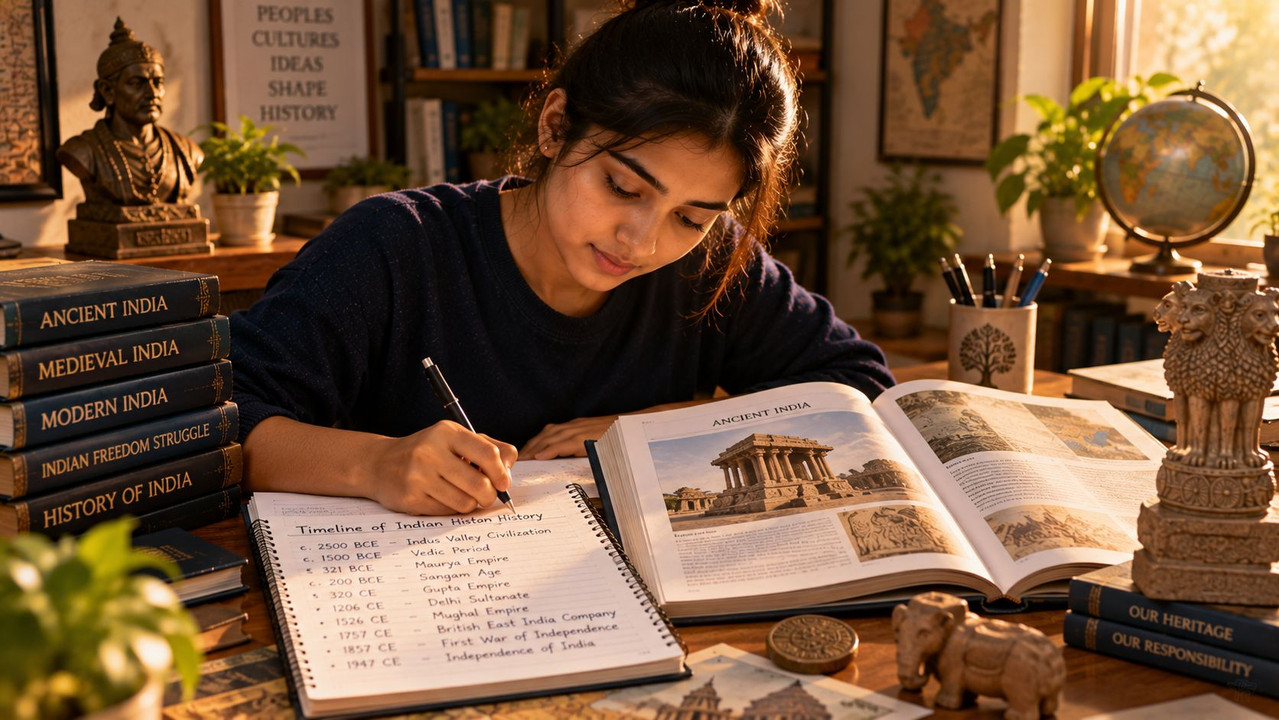
Indian History is a core static GK section across SSC, UPSC, Banking, Railway and State PSC exams, with recurring questions on ancient civilizations, religious movements, major dynasties, and their key rulers, battles and achievements. This guide compiles the essential facts across six major eras — from the Indus Valley Civilization through the Mughal Empire and the Bhakti-Sufi movements — organised for quick revision and long-term recall.
Ancient Civilizations — Indus Valley Civilization
- Also known as: Harappan Civilization; one of the world's oldest urban civilizations, contemporary with Egyptian and Mesopotamian civilizations
- Time period: Approximately 2500 BCE to 1900 BCE (mature phase)
- Discovery: First discovered at Harappa (1921) by Daya Ram Sahni; Mohenjo-daro (1922) by R.D. Banerji
- Key sites and their features:
| Site | Location | Key Feature |
|---|---|---|
| Harappa | Punjab, Pakistan | First site discovered; granaries, cemetery H |
| Mohenjo-daro | Sindh, Pakistan | "Mound of the Dead"; Great Bath, Great Granary |
| Lothal | Gujarat, India | Dockyard; evidence of maritime trade |
| Dholavira | Gujarat, India | Water conservation system; unique signboard |
| Kalibangan | Rajasthan, India | Evidence of ploughed field; fire altars |
| Rakhigarhi | Haryana, India | One of the largest Harappan sites discovered |
- Key features: Well-planned grid-pattern town planning, advanced drainage systems, standardised weights and measures, and undeciphered Harappan script; no clear evidence of temples or a centralised political authority
- Economy: Primarily agrarian, supplemented by extensive trade with Mesopotamia; worshipped Mother Goddess and possibly a proto-Shiva deity (Pashupati seal)
- Decline: Theories include climate change, river shifting (Saraswati/Ghaggar-Hakra drying up), floods, and Aryan invasion (largely discredited by modern scholarship in favour of internal/environmental factors)
Buddhism & Jainism — 6th Century BCE Reform Movements
Both religions emerged in the 6th century BCE as reactions against the rigid caste system and ritualistic excesses of Vedic Brahmanism.
Buddhism
- Founder: Siddhartha Gautama (Gautama Buddha), born in Lumbini (present-day Nepal) around 563 BCE
- Key life events: Attained enlightenment at Bodh Gaya under the Bodhi tree; gave his first sermon at Sarnath ("Dharmachakra Pravartana"); attained Mahaparinirvana (death) at Kushinagar
- Core teachings: Four Noble Truths, Eightfold Path (Madhyama Marga/Middle Path), rejection of the caste system and Vedic authority
- Buddhist Councils: 4 major councils held, the most significant being the 3rd Council under Emperor Ashoka at Pataliputra and the 4th Council under Kanishka in Kashmir
- Schisms: Split into Hinayana (Theravada) and Mahayana schools
Jainism
- 24th and last Tirthankara: Mahavira (Vardhamana), a contemporary of Buddha, born in Vaishali (Bihar)
- 1st Tirthankara: Rishabhanatha (Adinatha)
- Core principles: Ahimsa (non-violence), Satya (truth), Asteya (non-stealing), Brahmacharya (celibacy), Aparigraha (non-possession) — collectively the Panch Mahavrata
- Schisms: Split into Digambara (sky-clad) and Shvetambara (white-clad) sects
- Key councils: Councils at Pataliputra and Vallabhi compiled Jain texts (Agamas)
Exam tip: Buddha and Mahavira are frequently confused for their birthplaces and dates — Buddha was born at Lumbini, attained enlightenment at Bodh Gaya, and died at Kushinagar; Mahavira was born at Vaishali (Kundagrama) and attained nirvana at Pavapuri.
Maurya Period (c. 322 BCE - 185 BCE)
- Founder: Chandragupta Maurya, with guidance from his mentor Chanakya (Kautilya), author of the "Arthashastra"; overthrew the Nanda dynasty
- Key rulers:
| Ruler | Key Achievement |
|---|---|
| Chandragupta Maurya | Founded the empire; defeated Seleucus Nicator (Greek general) |
| Bindusara | Expanded the empire further south |
| Ashoka the Great | Greatest Mauryan ruler; conquered Kalinga (261 BCE), after which he embraced Buddhism and non-violence |
- Ashoka's contributions: Propagated Buddhism through edicts inscribed on rocks and pillars across the empire; sent missionaries abroad (including his son Mahendra and daughter Sanghamitra to Sri Lanka); the Lion Capital of Ashoka at Sarnath became independent India's national emblem
- Administration: Highly centralised administration with a vast espionage network, described in detail in the "Arthashastra" and by the Greek ambassador Megasthenes (author of "Indica") who visited Chandragupta's court
- Decline: The empire declined after Ashoka's death, ending with the assassination of the last Mauryan ruler Brihadratha by his general Pushyamitra Shunga (founder of the Shunga dynasty)
Gupta Period (c. 320 CE - 550 CE) — The "Golden Age"
- Founder: Sri Gupta; the empire's rise began properly with Chandragupta I
- Key rulers:
| Ruler | Key Achievement |
|---|---|
| Chandragupta I | Founded the Gupta Empire proper (c. 320 CE); took the title "Maharajadhiraja" |
| Samudragupta | Called the "Napoleon of India" for his extensive military conquests; achievements recorded in the Allahabad Prashasti (Pillar Inscription) composed by Harisena |
| Chandragupta II (Vikramaditya) | Golden Age peak; defeated the Shakas; his court included the "Navaratnas" (nine gems), including poet Kalidasa |
- Why called the "Golden Age": Remarkable achievements in art, architecture, science, mathematics and literature
- Aryabhata: Pioneering mathematician-astronomer; wrote the "Aryabhatiya"; proposed that the Earth rotates on its axis and calculated the value of pi
- Kalidasa: Greatest Sanskrit poet-dramatist of the era; wrote "Abhijnanashakuntalam," "Meghaduta," "Raghuvamsha"
- Chinese traveller Fa-Hien: Visited India during Chandragupta II's reign and documented the prosperity of the empire
- Nalanda University: Flourished as a major centre of Buddhist learning during this period
- Iron Pillar of Delhi: A metallurgical marvel from the Gupta era, still rust-resistant today
- Decline: Weakened by Hun invasions (Huna tribes) in the late 5th and early 6th centuries CE
Delhi Sultanate (1206 CE - 1526 CE)
Five dynasties ruled Delhi in succession over three centuries before the Mughal conquest.
| Dynasty | Period | Key Ruler(s) |
|---|---|---|
| Slave (Mamluk) Dynasty | 1206-1290 | Qutb-ud-din Aibak (founder, began Qutub Minar); Iltutmish; Razia Sultana (first and only woman ruler of Delhi) |
| Khalji Dynasty | 1290-1320 | Alauddin Khalji — introduced market control reforms; repelled Mongol invasions |
| Tughlaq Dynasty | 1320-1414 | Muhammad bin Tughlaq — shifted capital to Devagiri (Daulatabad); introduced token currency |
| Sayyid Dynasty | 1414-1451 | Khizr Khan (founder); weak, short-lived rule |
| Lodi Dynasty | 1451-1526 | Ibrahim Lodi — last Delhi Sultanate ruler, defeated by Babur at the First Battle of Panipat (1526) |
Key administrative features: Introduction of the Iqta system (land revenue assignments to nobles/officers in lieu of salary); Persian became the court language; significant Indo-Islamic architectural developments (Qutub Minar, Alai Darwaza)
Exam tip: Razia Sultana, daughter of Iltutmish, remains the only woman to have ruled Delhi as Sultan — a frequently repeated exam fact.
Mughal Empire (1526 CE - 1857 CE)
| Ruler | Reign | Key Achievement |
|---|---|---|
| Babur | 1526-1530 | Founded the empire after winning the First Battle of Panipat (1526) against Ibrahim Lodi |
| Humayun | 1530-1556 | Briefly lost the throne to Sher Shah Suri (founder of the Sur Empire, known for the Grand Trunk Road and rupiya coin); regained it before his death |
| Akbar | 1556-1605 | Greatest Mughal emperor; won the Second Battle of Panipat (1556); introduced Din-i-Ilahi, the Mansabdari system, and Sulh-i-Kul (policy of religious tolerance) |
| Jahangir | 1605-1627 | Known for justice (Zanjeer-i-Adl/chain of justice); patron of art and painting |
| Shah Jahan | 1628-1658 | Built the Taj Mahal (in memory of Mumtaz Mahal), Red Fort, and Jama Masjid; era called the "Golden Age of Mughal architecture" |
| Aurangzeb | 1658-1707 | Last powerful Mughal emperor; expanded the empire to its greatest territorial extent but reversed religious tolerance policies, reimposing the Jizya tax |
Decline: After Aurangzeb's death in 1707, the empire weakened due to weak successors, regional revolts (Marathas, Sikhs, Rajputs), and increasing European colonial intervention, ending formally when the last Mughal emperor Bahadur Shah II was exiled by the British after the 1857 Revolt.
Exam tip: Two "Battles of Panipat" are frequently confused — the First (1526, Babur vs. Ibrahim Lodi) founded the Mughal Empire; the Second (1556, Akbar's forces vs. Hemu) consolidated it. A Third Battle of Panipat (1761) was fought much later between the Marathas and Ahmad Shah Abdali.
Bhakti & Sufi Movements (Medieval Period)
Both movements emphasised personal devotion over ritualism and promoted communal harmony between Hindus and Muslims.
Bhakti Movement
- Emphasised devotion (bhakti) to a personal god, rejecting caste distinctions and elaborate rituals
- Key saints:
| Saint | Region/Language | Contribution |
|---|---|---|
| Ramanuja | South India | Propounded Vishishtadvaita philosophy |
| Kabir | North India (Hindi/Bhojpuri) | Blended Hindu and Islamic ideas; wrote in simple dohas (couplets) |
| Guru Nanak | Punjab | Founder of Sikhism; emphasised one formless God |
| Meera Bai | Rajasthan | Devotee of Krishna; composed devotional bhajans |
| Chaitanya Mahaprabhu | Bengal | Popularised Krishna bhakti and sankirtan (devotional singing) |
| Tulsidas | North India | Wrote the "Ramcharitmanas" in Awadhi |
Sufi Movement
- Mystical strand of Islam emphasising personal experience of the divine through love, music (sama) and poetry, rather than strict orthodoxy
- Key Sufi orders (Silsilas): Chishti, Suhrawardi, Qadiri, Naqshbandi
- Key figures:
| Sufi Saint | Order | Key Detail |
|---|---|---|
| Khwaja Moinuddin Chishti | Chishti | Founder of the Chishti order in India; dargah at Ajmer, Rajasthan |
| Nizamuddin Auliya | Chishti | Prominent Delhi-based Sufi saint; dargah in Delhi |
| Baba Farid | Chishti | Punjab-based; verses later included in the Guru Granth Sahib |
Common ground: Both Bhakti and Sufi movements used vernacular (local) languages instead of Sanskrit or Persian/Arabic to reach ordinary people, and both emphasised love, devotion and equality over ritual and hierarchy — contributing significantly to India's syncretic (composite) culture.
How Exams Test This Topic — Question Patterns to Watch
- Ruler-to-achievement matching: A very common format — e.g., "Who built the Taj Mahal?" or "Who introduced the Din-i-Ilahi?" Keep dynasty-wise tables handy for quick matching.
- Battle identification: The three Battles of Panipat, and battles like the Battle of Plassey (1757, later British period) are frequently tested with their causes and outcomes.
- Foreign traveller accounts: Megasthenes (Mauryan period), Fa-Hien and Hiuen Tsang (Gupta period), Ibn Battuta (Delhi Sultanate) are frequently linked to the specific ruler/period they documented.
- Council and text matching: Buddhist councils, Jain councils, and their associated rulers and outcomes are a recurring UPSC-level question type.
- Architecture-to-ruler matching: Qutub Minar (started by Aibak, completed by Iltutmish), Taj Mahal (Shah Jahan), Iron Pillar (Gupta period) — a classic "who built what" trap category.
Frequently Asked Questions
Q1. Who founded the Mauryan Empire, and who was his key advisor?
Chandragupta Maurya founded the Mauryan Empire around 322 BCE with the guidance of his mentor Chanakya (also known as Kautilya or Vishnugupta), who authored the "Arthashastra," a treatise on statecraft, economics and military strategy. Chandragupta overthrew the Nanda dynasty to establish Mauryan rule over much of the Indian subcontinent.
Q2. Why is the Gupta period called the "Golden Age" of India?
The Gupta period (c. 320-550 CE) is called the "Golden Age" because of its remarkable achievements in science, mathematics, art, architecture and literature, including the work of mathematician-astronomer Aryabhata and poet-dramatist Kalidasa. This era also saw the flourishing of Nalanda University as a centre of learning and the construction of the metallurgically advanced Iron Pillar of Delhi.
Q3. Who was the only woman to rule the Delhi Sultanate?
Razia Sultana, the daughter of Sultan Iltutmish of the Slave (Mamluk) Dynasty, was the only woman to rule as Sultan of Delhi, reigning from 1236 to 1240 CE. Her rule is frequently tested in exams as a standalone fact given her unique position in medieval Indian history.
Q4. What is the key difference between the Bhakti and Sufi movements?
The Bhakti movement was a Hindu devotional movement emphasising personal devotion to a chosen deity and rejecting caste-based ritualism, propagated by saints like Kabir, Meera Bai and Chaitanya Mahaprabhu, while the Sufi movement was a mystical strand within Islam emphasising love and spiritual connection with the divine through poetry and music, led by saints like Khwaja Moinuddin Chishti and Nizamuddin Auliya. Both movements used vernacular languages and promoted communal harmony, contributing to India's composite culture during the medieval period.
Q5. Which battle marked the founding of the Mughal Empire, and which battle marked its effective consolidation?
The First Battle of Panipat (1526), in which Babur defeated Ibrahim Lodi of the Delhi Sultanate, marked the founding of the Mughal Empire in India, while the Second Battle of Panipat (1556), in which Akbar's forces defeated Hemu, is considered the decisive battle that consolidated Mughal rule after a brief interruption by Sher Shah Suri's Sur Empire. Both battles are frequently tested together with the later Third Battle of Panipat (1761) between the Marathas and Ahmad Shah Abdali, which occurred well after the Mughal peak.
Get Instant Government Job Alerts
Never miss a notification, admit card, or result. Join our free channels for daily sarkari naukri updates delivered straight to your phone:
- 💬 WhatsApp Channel: Join Now
- 📢 Telegram Channel: Join @govtjobsiojobs



Leave a Reply
Be the first to comment.