Introduction
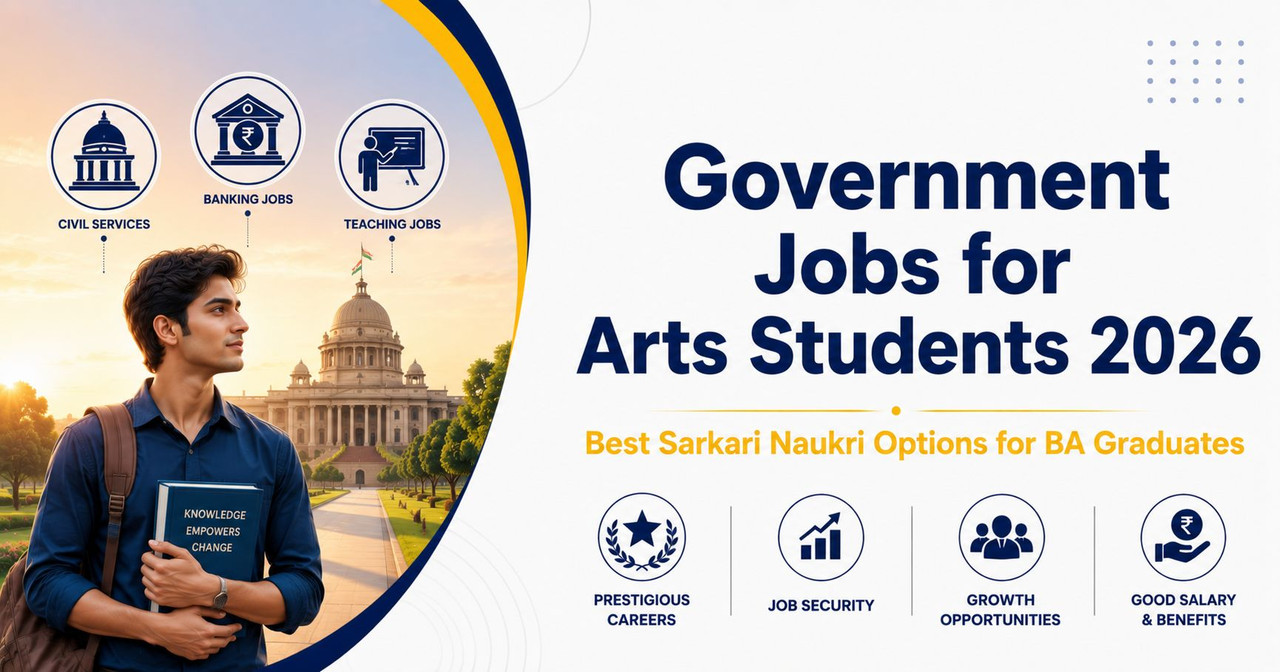
If you're a BA graduate wondering whether an Arts degree limits your government job options, the reality is quite the opposite — government jobs for arts students in 2026 are among the widest and most prestigious available in India, spanning the country's most sought-after administrative, banking, and civil services exams. From UPSC Civil Services to SSC CGL to state PSC administrative posts, an Arts background in subjects like History, Political Science, Economics, Sociology, or English is not just accepted but often genuinely advantageous for exams that test general studies, governance, and administrative aptitude. This guide covers the major government career paths open to Arts graduates in 2026.
Many Arts students underestimate their competitive position, assuming technical or commerce degrees carry more weight in government recruitment — in reality, subjects like History, Political Science, and Public Administration directly overlap with the General Studies syllabus tested in India's most prestigious exams, giving Arts graduates a genuine head start in several cases.
1. UPSC Civil Services Examination (IAS/IPS/IFS and Allied Services)
This is the pinnacle government career path for many Arts graduates. The UPSC Civil Services Exam tests General Studies extensively — covering History, Polity, Geography, Economy, and Ethics — subjects that align closely with a typical Arts curriculum. Optional subjects for the Mains exam also include History, Political Science & International Relations, Sociology, Public Administration, Geography, and Philosophy, all directly drawn from common Arts degree specialisations, giving BA graduates a natural preparation advantage if they choose a related optional subject.
2. SSC CGL and Other SSC Exams
Staff Selection Commission's Combined Graduate Level exam is open to graduates of any discipline, including Arts, and recruits for a wide range of Group B and Group C central government posts — Income Tax Inspector, Assistant Section Officer, Auditor, and many more. SSC exams primarily test General Intelligence, Quantitative Aptitude, English, and General Awareness — none of which require a specific technical or commerce background.
3. Banking Sector (IBPS, SBI, RBI)
Banking recruitment exams (IBPS PO/Clerk, SBI PO/Clerk, RBI Assistant/Grade B) are open to "Any Graduate" and test Reasoning, Quantitative Aptitude, English Language, and General/Banking Awareness — none of which require a commerce or finance-specific degree, making banking one of the most accessible and rewarding career paths for Arts graduates.
4. Teaching Profession (Government Schools)
Arts graduates with a B.Ed qualification have a direct and natural path into government school teaching, through state-level Teacher Eligibility Tests (TET/STET) and subsequent recruitment drives for subjects like History, Political Science, Geography, Sociology, and English at the secondary and higher secondary level. Given the consistent, ongoing demand for subject teachers across India's vast government school network, teaching remains one of the most stable long-term career options for Arts graduates.
5. State Public Service Commissions (State PSCs)
Every state's PSC — such as UPPSC, BPSC, MPPSC, RPSC — conducts its own state civil services exam, structured very similarly to UPSC, with a heavy emphasis on General Studies and state-specific History, Geography, and Culture. Arts graduates, particularly those with subjects like History or Political Science, often find these state-level exams a natural extension of their academic background, while also benefiting from typically less nationwide competition compared to UPSC.
6. Judicial Services (with LLB)
Arts graduates who pursue an LLB after their BA (a common combination, especially for Political Science and History graduates) become eligible for State Judicial Services exams, recruiting Civil Judges and Judicial Magistrates — a highly respected career path combining legal expertise with public service.
7. Defence and Paramilitary Officer Entries
Arts graduates are equally eligible for UPSC's Combined Defence Services (CDS) exam and various Short Service Commission entries into the Indian Army, Navy, and Air Force — these exams don't require a technical background for non-technical entry streams, and instead test general knowledge, English, and elementary mathematics alongside physical and personality assessment.
Why Arts Graduates Have a Genuine Edge in Government Exams
- General Studies overlap: History, Polity, Geography, and Economy — core General Studies subjects in UPSC, State PSC, and SSC exams — are often already part of a typical Arts curriculum
- Optional subject advantage: UPSC and several State PSC Mains exams allow candidates to choose an optional subject from their academic background (History, Political Science, Sociology, Public Administration, Geography), letting Arts graduates leverage existing subject depth rather than starting from scratch
- Strong English and communication skills: Many Arts programmes emphasise essay writing, comprehension, and articulation — directly useful for exams with descriptive papers, interviews, and personality tests
Preparation Tips for Arts Graduates Targeting Government Jobs
- If targeting UPSC or State PSC, choose an optional subject that overlaps with your degree specialisation to reduce preparation time significantly
- Build a strong current affairs habit early — General Studies papers across nearly every major exam draw heavily on recent national and international developments
- For banking and SSC exams, dedicate focused time to Quantitative Aptitude and Reasoning specifically, since these sections are less naturally covered in a typical Arts curriculum and often need separate, structured practice
- If teaching interests you, complete your B.Ed alongside or immediately after your BA to keep your eligibility timeline for TET/STET exams on track
Get Instant Government Job Alerts
Never miss a notification, admit card, or result. Join our free channels for daily sarkari naukri updates delivered straight to your phone:
- 💬 WhatsApp Channel: Join Now
- 📢 Telegram Channel: Join @govtjobsiojobs

Leave a Reply
Be the first to comment.