Introduction
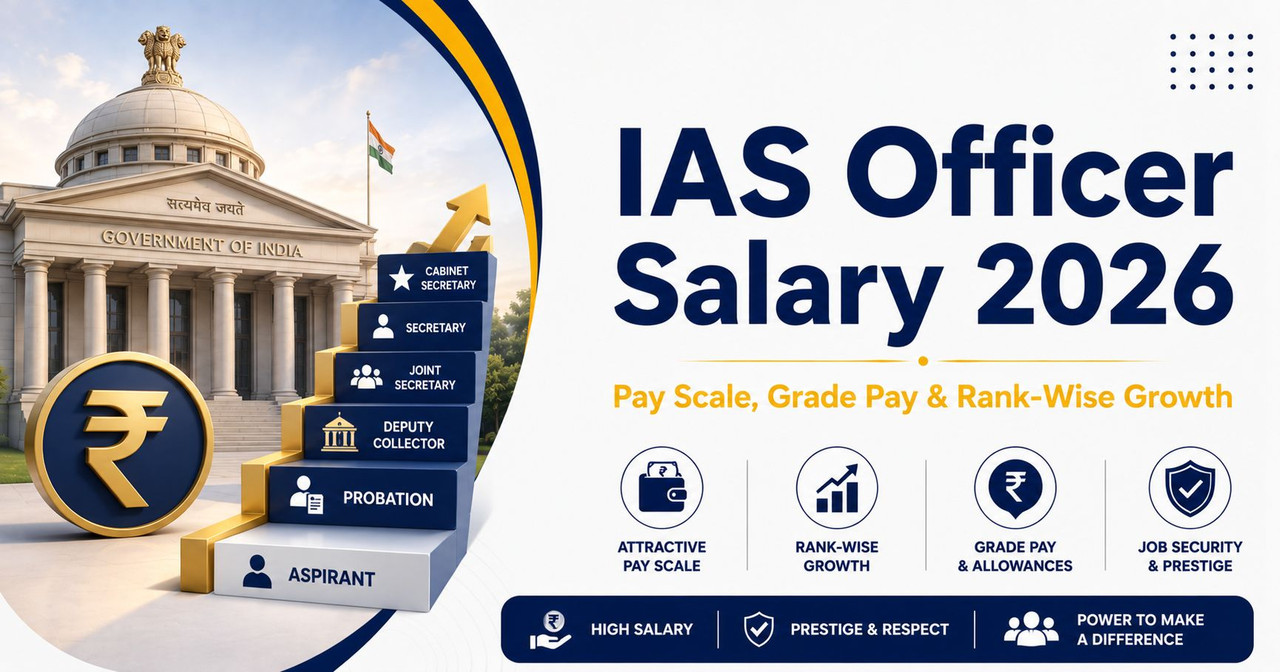
IAS Officer Salary 2026 is one of the most researched topics among UPSC Civil Services aspirants, and understandably so — the Indian Administrative Service offers not just India's most prestigious government career, but a structured, transparent pay progression that rises from entry-level postings all the way to the Cabinet Secretary, the highest bureaucratic position in the country. This guide breaks down the complete IAS salary structure under the current 7th Pay Commission, rank by rank, along with allowances and how compensation grows over a career.
Unlike many private-sector careers where pay negotiation varies individual to individual, IAS salary is entirely governed by a fixed, transparent Pay Matrix — meaning every officer at the same pay level and service stage earns an identical basic pay, with variation coming only from posting-linked allowances like HRA.
IAS Starting Salary — Pay Level 10
A newly appointed IAS officer, typically posted as a Sub-Divisional Magistrate (SDM), Assistant Collector, Under Secretary, or Assistant Secretary, starts at Pay Level 10 of the 7th Pay Commission Pay Matrix, with a basic pay of ₹56,100 per month. This is the fixed entry-level basic pay for every IAS officer, regardless of their UPSC rank or exam performance — rank determines cadre/state allocation and, to some extent, seniority within the batch, not starting pay.
With Dearness Allowance, House Rent Allowance, Travel Allowance, and other applicable perks added, the effective in-hand salary for an entry-level IAS officer is typically around ₹70,000 to ₹80,000 per month, though this varies based on posting location and current DA rate.
IAS Rank-Wise Salary Progression
| Career Stage | Approx. Years of Service | Pay Level | Approx. Basic Pay |
|---|---|---|---|
| Sub-Divisional Magistrate (SDM) / Assistant Secretary | 1-4 years | Level 10 | ₹56,100 |
| Additional District Magistrate / Deputy Secretary | 5-8 years | Level 11 | ₹67,700+ |
| District Magistrate / Director | 9-12 years | Level 12 | ₹78,800+ |
| District Magistrate (Senior) / Joint Secretary (State) | 13-16 years | Level 13 | ₹1,18,500+ |
| Divisional Commissioner / Secretary (State) | 16-24 years | Level 14 | ₹1,44,200+ |
| Principal Secretary / Additional Secretary (Centre) | 25-30 years | Level 15 | ₹1,82,200+ |
| Additional Chief Secretary / Special Secretary (Centre) | 30-33 years | Level 16 | ₹2,05,400+ |
| Chief Secretary (State) / Secretary (Centre) | 34+ years | Level 17 | ₹2,25,000+ |
| Cabinet Secretary of India | Apex Position | Level 18 | ₹2,50,000 (fixed) |
Exact promotion timelines vary by state cadre, batch-specific vacancy availability, and individual performance — the years-of-service figures above are indicative, not guaranteed.
IAS Salary Components — Full Breakdown
- Basic Pay: As per the Pay Level table above, fixed under the 7th CPC Pay Matrix
- Dearness Allowance (DA): A cost-of-living adjustment, revised periodically (typically half-yearly) based on the Consumer Price Index, currently forming a significant percentage of basic pay
- House Rent Allowance (HRA): 24%, 16%, or 8% of basic pay depending on whether the posting city falls in X (metro), Y (urban), or Z (semi-urban/rural) category — though many IAS officers are provided official government accommodation instead, in which case HRA is not separately drawn
- Travel Allowance (TA): For official travel and transfers
- Medical Facilities: Comprehensive medical coverage for the officer and dependents, often including access to government hospitals and empanelled private facilities
- Official Perks: Depending on posting and seniority, IAS officers may also receive an official vehicle, household staff allowance, and other administrative support facilities tied to their specific post
IAS vs IPS Salary — Are They the Same?
At the entry level, IAS and IPS (Indian Police Service) officers both start at an identical Pay Level 10 with the same ₹56,100 basic pay — the two services diverge in their long-term ceiling. The topmost IAS position, Cabinet Secretary, sits at Pay Level 18, while the highest IPS pay level (Director General of Police / equivalent Apex Scale) tops out at Level 17 — meaning IAS carries a marginally higher salary ceiling at the very peak of a career, though both services offer extremely strong long-term compensation and career authority.
Does IAS Salary Vary Between State and Central Postings?
The core basic pay structure under the 7th CPC Pay Matrix is uniform for IAS officers regardless of whether they're serving in a state cadre posting or on Central Deputation — however, allowances (particularly HRA, since city classifications and cost of living vary) and specific perks can differ somewhat between state-level and central government postings.
Beyond Salary — Why IAS Compensation Is Considered Comprehensive
- Job security: IAS is a constitutionally protected All India Service, offering exceptional long-term job stability
- Pension and retirement benefits: IAS officers are covered under applicable central government pension/retirement schemes
- Government accommodation: Many postings, especially at District Magistrate level and above, come with official government housing
- Authority and impact: Beyond the direct salary figure, IAS officers hold substantial administrative authority — overseeing districts, implementing government policy, and managing significant public resources — a dimension of the role that goes well beyond the pay slip
Get Instant Government Job Alerts
Never miss a notification, admit card, or result. Join our free channels for daily sarkari naukri updates delivered straight to your phone:
- 💬 WhatsApp Channel: Join Now
- 📢 Telegram Channel: Join @govtjobsiojobs

Leave a Reply
Be the first to comment.