Introduction
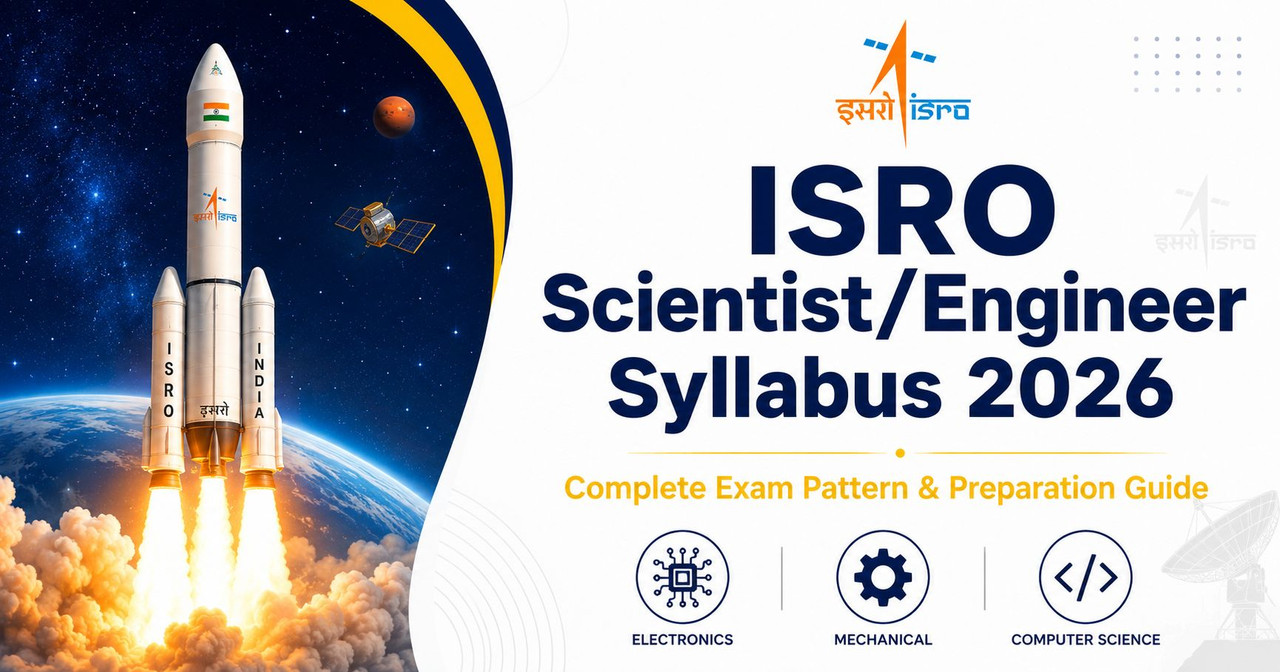
If you're preparing for the ISRO Scientist/Engineer 'SC' exam 2026, you're aiming for one of the most prestigious engineering government jobs in India. The Indian Space Research Organisation (ISRO), through its Centralised Recruitment Board (ICRB), hires engineering graduates for Scientist/Engineer posts across disciplines like Mechanical, Electronics & Communication, Computer Science, and Electrical Engineering. This ISRO Scientist syllabus 2026 guide covers the exact exam pattern, subject-wise topics for every major branch, the marking scheme, and the interview process — everything you need to plan an effective preparation strategy for this sarkari naukri opportunity in space technology.
Unlike many PSU recruitments that accept GATE scores, ISRO conducts its own written examination, which means candidates need a preparation plan built specifically around the ICRB pattern rather than generic GATE material. This guide breaks down exactly what to study and how marks are distributed, so you can prioritise your revision time on the topics that matter most.
ISRO Scientist/Engineer Selection Process 2026
The ISRO Scientist/Engineer 'SC' recruitment follows a two-stage selection process:
- Written Test (Computer-Based Test) — tests both core engineering knowledge and general aptitude
- Personal Interview — assesses technical depth, communication skills, and awareness of ISRO's ongoing missions and achievements
The final merit list is prepared by combining both stages equally: 50% weightage from the Written Test and 50% weightage from the Interview. This equal split makes the interview just as important as the written exam — a candidate who scores well on paper but performs poorly in the interview can still lose out to someone with a more balanced performance across both stages.
Only candidates who clear the minimum qualifying marks in the written test move forward. Shortlisting for the interview is typically done in a ratio of around 1:5 based on written test merit, meaning roughly five candidates are called for interview for every one final vacancy in that discipline.
ISRO Scientist Exam Pattern 2026
The written examination is divided into two parts:
Part A — Core Engineering (Discipline-Specific) This section carries the highest weightage — roughly 80% of the total written test marks — and tests undergraduate-level engineering knowledge specific to the candidate's branch (Mechanical, Electronics, Computer Science, Electrical, etc.). Questions are generally more direct and conceptual compared to GATE-level questions, focusing on fundamental understanding rather than highly complex numerical problems.
Part B — General Aptitude This section is common across all engineering disciplines and typically carries around 20% of the total marks, spread across roughly 15 questions. It tests numerical ability, logical reasoning, abstract reasoning, and diagrammatic reasoning. Importantly, Part B usually carries no negative marking, so candidates are advised to attempt every question in this section — even an educated guess gives you a reasonable chance of scoring, unlike Part A where wrong answers typically cost you marks.
The overall written test is conducted over a duration of approximately 120 minutes (2 hours), with a total of around 100 marks combining both parts. Negative marking applies to Part A, with roughly one-third mark deducted per incorrect answer in most cycles — always confirm the exact negative marking ratio from your specific year's official notification, as ISRO has varied this slightly across cycles.
ISRO Scientist Syllabus — Branch-Wise Breakdown
Electronics & Communication Engineering (ECE)
- Network Theory
- Signals & Systems
- Control Systems
- Analog & Digital Circuits
- Electromagnetics
- Microprocessors
- Communication Systems (Analog & Digital)
- VLSI Design
Mechanical Engineering
- Engineering Mechanics & Strength of Materials
- Thermodynamics & Heat Transfer
- Fluid Mechanics
- Theory of Machines & Vibrations
- Manufacturing Science & Production
- Material Science
- Machine Design
- Industrial Engineering
Computer Science & Engineering
- Data Structures & Algorithms
- Programming (C/C++/Python)
- Operating Systems
- Computer Networks
- Database Management Systems (DBMS) & SQL
- Computer Architecture
- Software Engineering
- Compiler Design
Electrical Engineering
While the exact topic list varies by year, Electrical Engineering candidates should expect coverage of Power Systems, Electrical Machines, Control Systems, Power Electronics, Electrical Measurements, and Network Theory, aligned closely with a standard undergraduate B.E./B.Tech Electrical curriculum.
Candidates should note that the ISRO Scientist syllabus for each discipline closely mirrors the standard undergraduate engineering curriculum for that branch — there is no need to study beyond your regular B.E./B.Tech syllabus, but a strong conceptual grasp across every core subject in your branch is essential, since questions can be drawn from any part of the curriculum.
Minimum Qualifying Marks
ISRO typically sets minimum qualifying criteria for both Part A and Part B individually, as well as an aggregate cutoff:
- General/EWS/OBC candidates: Minimum 50% in each part of the written test, and 60% aggregate
- PwBD candidates: Minimum 40% in each part, and 50% aggregate
These qualifying marks can vary slightly between recruitment cycles, so candidates should always cross-check against the specific year's official notification before finalising their preparation targets.
Is GATE Score Required for ISRO Scientist Recruitment?
No — a GATE score is not mandatory for the ISRO Scientist/Engineer 'SC' recruitment. ISRO conducts its own independent written examination through the ICRB, separate from GATE-based recruitment routes used by some other PSUs like ONGC or IOCL. This means candidates who haven't appeared for GATE, or who didn't score well in it, still have a full and equal opportunity to qualify for ISRO through this direct exam route.
ISRO Scientist Salary and Career Growth
Selected candidates join at the Scientist/Engineer 'SC' level, which corresponds to Pay Level 10 under the 7th Pay Commission. In-hand salary typically ranges from approximately ₹75,000 to ₹85,000 per month after allowances, though this varies based on posting location and applicable Dearness Allowance rates. Beyond the starting salary, ISRO offers a structured career progression through Scientist/Engineer grades (SD, SE, SF, and beyond), along with the unique opportunity to work on India's marquee space missions such as Chandrayaan, Gaganyaan, and various satellite launch programmes.
Preparation Tips for ISRO Scientist Exam 2026
- Build your preparation around your core B.E./B.Tech syllabus rather than external advanced material — Part A tests direct conceptual understanding, not GATE-level complexity
- Since Part B (Aptitude) has no negative marking in most cycles, never leave it incomplete — attempt every question
- Practice previous years' ISRO papers specifically, as question style differs meaningfully from GATE or other PSU exams
- Revise numerical-heavy topics (Strength of Materials for Mechanical, Network Theory for ECE/EE, Data Structures for CS) thoroughly, as these tend to carry consistent weightage
- Don't neglect interview preparation — since it carries equal weightage to the written test, brush up on your final-year projects, core subject fundamentals, and current ISRO mission updates
Get Instant Government Job Alerts
Never miss a notification, admit card, or result. Join our free channels for daily sarkari naukri updates delivered straight to your phone:
- 💬 WhatsApp Channel: Join Now
- 📢 Telegram Channel: Join @govtjobsiojobs

Leave a Reply
Be the first to comment.