Introduction
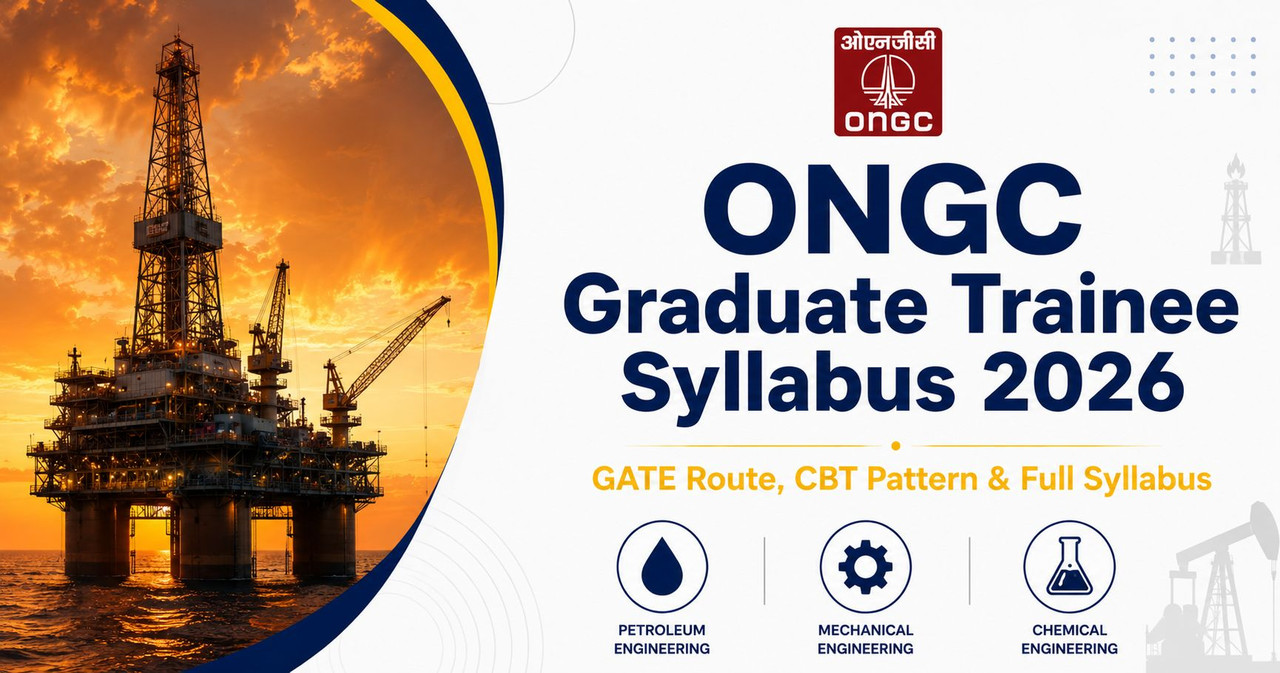
Planning to appear for ONGC Graduate Trainee recruitment 2026? Oil and Natural Gas Corporation Limited (ONGC), India's largest Maharatna PSU in the oil and gas exploration sector, hires Graduate Trainees (GT) at the E1 executive level every year across disciplines including Petroleum Engineering, Mechanical, Chemical, Instrumentation, and Geology. This ONGC Graduate Trainee syllabus 2026 guide walks you through both recruitment routes ONGC uses — GATE-based shortlisting and its own Computer-Based Test — along with the complete subject-wise syllabus and selection process, so you know exactly how to prepare regardless of which route your recruitment cycle follows.
ONGC is one of the most financially rewarding and stable PSU career destinations for engineering and geoscience graduates in India, given the company's central role in the country's energy security. Understanding the correct exam pattern for your specific recruitment cycle is the first step toward cracking this competitive government job.
ONGC Graduate Trainee — Two Recruitment Routes
ONGC has historically used two different pathways to recruit Graduate Trainees, and candidates must first identify which route applies to their specific notification:
Route 1: GATE-Based Recruitment In several recent cycles, ONGC has recruited Graduate Trainees directly through GATE (Graduate Aptitude Test in Engineering) scores. Under this route, candidates first appear for GATE in their relevant discipline, and ONGC shortlists candidates based on their GATE score/rank, bypassing a separate written test. Shortlisted candidates then proceed to a Group Discussion and Personal Interview.
Route 2: ONGC's Own Computer-Based Test (CBT) In other cycles, ONGC conducts its own independent written examination (CBT) instead of relying on GATE scores, followed by an interview for shortlisted candidates. This route is more similar to how organisations like ISRO or SSC conduct in-house exams.
Always check your specific year's official notification carefully to confirm which route is being followed, since the syllabus, preparation approach, and timeline differ meaningfully between the two.
Route 1: GATE-Based Selection Process
- Appear in GATE (current year) in your relevant engineering/geoscience discipline
- ONGC releases its recruitment notification and opens online applications at ongcindia.com
- ONGC shortlists candidates based on GATE score/rank in a ratio of approximately 1:5 for further stages
- Group Discussion (GD) — typically carrying around 25-30 marks
- Personal Interview (PI) — typically carrying around 75 marks
- Medical Examination (Fit/Unfit certification)
- Final Merit List — based on combined GD + PI score, since GATE is used only for initial shortlisting, not for final ranking
GATE Score/Rank Guidance: Historically, General category candidates have needed a GATE rank below approximately 600 to be shortlisted, OBC candidates below approximately 800, SC candidates below approximately 3,000, and ST candidates below approximately 4,000 — though these cutoffs vary significantly by discipline and year, so treat them as rough indicative benchmarks only, not guaranteed thresholds.
Route 2: ONGC CBT Exam Pattern
When ONGC conducts its own Computer-Based Test, the exam is generally structured as follows (exact question count and marks have varied slightly across cycles — always verify against your specific notification):
- Total Questions: Approximately 85-100 objective-type MCQs
- Total Marks: Matching total questions (each question generally carries 1 mark)
- Duration: 2 hours (120 minutes)
- Sections: Concerned Domain/Technical Subject, General Awareness, Aptitude Test, and English Language
A typical section-wise split looks like this:
| Section | Approx. Questions | Approx. Marks |
|---|---|---|
| Concerned Domain (Technical) | 40 | 40 |
| Aptitude Test | 25 | 25 |
| General Awareness | 10 | 10 |
| English Language | 10 | 10 |
Negative Marking: Some ONGC CBT cycles have applied no negative marking, while others have applied a 0.25 mark deduction per wrong answer — this detail specifically changes between recruitment years, so confirm it from your current notification before deciding your attempt strategy on exam day.
ONGC Graduate Trainee Syllabus — Subject-Wise (Technical Domain)
Petroleum Engineering
Reservoir Engineering, Drilling Engineering, Well Completion, Production Technology, Petroleum Formation Evaluation, Oil & Gas Well Testing
Mechanical Engineering
Thermodynamics, Fluid Mechanics, Strength of Materials, Machine Design, Manufacturing Processes, Heat Transfer, Theory of Machines
Chemical Engineering
Chemical Reaction Engineering, Mass Transfer, Heat Transfer, Process Control, Fluid Mechanics, Process Equipment Design
Instrumentation Engineering
Process Control, Sensors & Transducers, Analytical Instrumentation, Control Systems, Signal Processing
Geology / Geophysics
Structural Geology, Petroleum Geology, Sedimentology, Stratigraphy, Geophysical Exploration Methods, Well Logging
Common Sections (All Streams)
- General Awareness: Current affairs, petroleum sector developments, government energy policy, ONGC's own history and operations
- Aptitude Test: Quantitative aptitude, logical reasoning, data interpretation
- English Language: Grammar, comprehension, vocabulary
Eligibility and Qualifying Marks
Candidates need a minimum aggregate of 60% marks in their full-time B.E./B.Tech (or relevant Master's for Geology) qualifying degree to meet the academic eligibility baseline. Final-year students are generally permitted to apply, provided they submit proof of their final qualification at the interview stage.
For the CBT route specifically, qualifying marks are typically set at 45% for General/EWS/OBC candidates and 40% for SC/ST/PwBD candidates in the written test. At the interview stage, General/EWS/OBC candidates typically need a minimum of 60% (e.g., 9 out of 15 marks) and SC/ST/PwBD candidates a minimum of 40% (e.g., 6 out of 15 marks) to qualify.
ONGC Graduate Trainee Salary and Career Growth
Selected candidates join at the E1 executive level, ONGC's entry grade for graduate engineers and geoscientists. The role offers a strong compensation package under ONGC's own executive pay scale, along with standard PSU benefits — provident fund, gratuity, medical coverage, housing/HRA, and a clear promotion trajectory through ONGC's executive grade structure (E1 through E9), making it one of the most financially attractive engineering PSU careers in India, especially given ONGC's Maharatna status and central role in national energy security.
Preparation Tips for ONGC Graduate Trainee 2026
- First confirm which route (GATE-based or CBT) your specific recruitment cycle follows — this fundamentally changes your preparation timeline and approach
- If preparing via the GATE route, treat your GATE preparation as the primary exam — GD and PI preparation should begin only once you're confident of a good GATE score
- If preparing via the CBT route, balance your technical subject revision with regular aptitude and general awareness practice, since all sections contribute to qualifying marks
- Stay updated on ONGC's recent projects, exploration blocks, and the broader oil & gas sector — this helps significantly in both General Awareness sections and interview rounds
- Practice previous years' ONGC papers (where the CBT route was used) to get familiar with question style and technical depth expected
Get Instant Government Job Alerts
Never miss a notification, admit card, or result. Join our free channels for daily sarkari naukri updates delivered straight to your phone:
- 💬 WhatsApp Channel: Join Now
- 📢 Telegram Channel: Join @govtjobsiojobs

Leave a Reply
Be the first to comment.