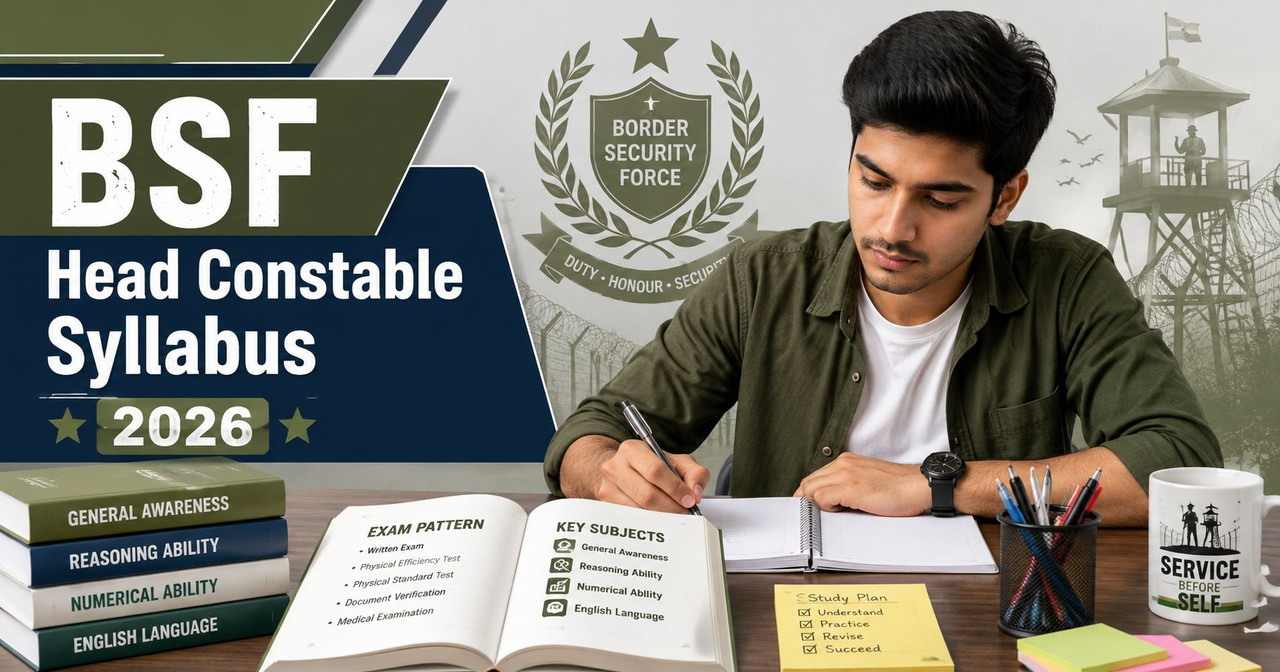
BSF Head Constable Syllabus 2026 — Complete Exam Pattern & Subject-Wise Guide
The Border Security Force (BSF) Head Constable exam is one of the most sought-after recruitment drives among candidates aiming for a career in India's premier border-guarding force. Every year, lakhs of aspirants apply for the Head Constable (Ministerial) and Head Constable (Radio Operator/Radio Mechanic) posts, making the competition intense and the need for a clear, structured syllabus essential. This guide covers the complete BSF Head Constable syllabus 2026, exam pattern, physical standards, and a subject-by-subject breakdown to help you plan your preparation effectively.
BSF recruits Head Constables under two broad streams — Head Constable (Ministerial), commonly called HCM, for clerical and administrative roles, and Head Constable (Radio Operator/Radio Mechanic), known as RO/RM, for technical and communication roles. Both streams share a similar overall selection structure but differ in their written exam subjects, since RO/RM candidates are tested on science and mathematics topics relevant to the technical nature of the post.
Is BSF Head Constable a Good Career Option?
BSF is one of India's largest paramilitary forces, tasked with guarding the country's international borders, particularly along Pakistan and Bangladesh. A Head Constable position offers job security, a central government pay scale, promotional avenues to Assistant Sub-Inspector and beyond, and a range of allowances including risk allowance, ration allowance, and dearness allowance. For candidates who have completed their 10+2 or graduation and are looking for a stable, respected government career with a strong sense of national service, BSF Head Constable recruitment is consistently one of the most popular options in the defence and paramilitary category.
BSF Head Constable Selection Process — Overview
The BSF Head Constable recruitment process consists of multiple stages, and candidates must clear each stage to proceed to the next:
- Physical Standard Test (PST) — height, chest, and weight measurements as per category and gender
- Physical Efficiency Test (PET) — running, and for some posts, additional physical tasks
- Written Examination (Tier 1) — objective-type test covering the core syllabus
- Skill Test / Typing Test — applicable for HCM candidates
- Document Verification
- Medical Examination
Only candidates who clear the PST and PET move forward to the written examination, so physical fitness preparation is just as important as academic preparation.
BSF Head Constable Physical Standard Test (PST)
Before the written exam, candidates must meet the minimum physical standards prescribed by BSF. These standards vary slightly by category and gender, and by region for certain hill and border communities that receive relaxation. Broadly, male candidates need to meet a minimum height and chest requirement (with chest expansion), while female candidates have a separate height and weight standard. Candidates from Scheduled Tribes and specified hill areas typically receive a relaxation in height and chest measurement as per government norms.
BSF Head Constable Physical Efficiency Test (PET)
The PET tests basic physical fitness through a timed race:
- Male candidates: 1.6 km race to be completed within a specified time limit (commonly around 6 minutes 30 seconds, though candidates should always confirm the exact cutoff from the official notification for the specific recruitment cycle)
- Female candidates: A shorter distance race with a proportionately adjusted time limit
Candidates who do not clear the PET within the prescribed time are eliminated from further stages, regardless of their academic preparation. It is strongly recommended that candidates begin physical training well in advance of the exam date rather than relying solely on last-minute practice.
BSF Head Constable Written Exam Pattern 2026
The written examination for BSF Head Constable is an objective-type (multiple choice) test conducted in OMR or online mode, depending on the recruitment cycle. Based on previous recruitment notifications, the general pattern for the Head Constable (Ministerial) written exam typically follows this structure:
- Total Questions: 100
- Total Marks: 200 (each question generally carries 2 marks in past HCM cycles — always verify the exact marking scheme against BSF's official notification PDF for the current recruitment year, as this has varied slightly across cycles)
- Duration: Around 100 minutes (1 hour 40 minutes)
- Negative Marking: 0.25 marks deducted for every incorrect answer
- Number of Sections: 4–5, covering English, Hindi, General Intelligence & Reasoning, Numerical Aptitude, and Clerical Aptitude/Basic Computer Knowledge
- Qualifying Marks: Around 35% for General/UR category and 33% for OBC, SC and ST candidates (exact percentages are confirmed in each notification)
For the RO/RM stream, the written exam replaces clerical and computer-based sections with science and mathematics topics, reflecting the technical nature of the Radio Operator/Radio Mechanic role.
BSF Head Constable (Ministerial) Syllabus — Subject Wise
1. General English
- Idioms and Phrases
- Sentence Improvement and Sentence Arrangement
- Synonyms and Antonyms
- Active and Passive Voice
- Direct and Indirect Speech
- Spelling Test and Error Detection
- Fill in the Blanks
- One-Word Substitution
- Comprehension Passages
2. General Hindi
- व्याकरण (सामान्य हिंदी व्याकरण)
- पर्यायवाची और विलोम शब्द
- मुहावरे एवं लोकोक्तियाँ
- वाक्य शुद्धि
- अनेकार्थी शब्द
- संधि एवं समास
3. General Intelligence and Reasoning
- Analogies
- Similarities and Differences
- Spatial Visualisation
- Problem-Solving and Analysis
- Judgement and Decision Making
- Visual Memory
- Discrimination and Observation
- Relationship Concepts
- Arithmetical Reasoning
- Verbal and Figure Classification
- Non-verbal Series
- Coding-Decoding
- Statement Conclusion
4. Numerical Aptitude
- Number Systems
- Whole Numbers, Decimals, Fractions
- Fundamental Arithmetical Operations
- Percentages
- Ratio and Proportion
- Averages
- Simple and Compound Interest
- Profit and Loss
- Discount
- Mensuration
- Time and Work
- Time and Distance
- Tables and Graphs
5. Clerical Aptitude / General Awareness
- Current Affairs — National and International
- Indian History and Culture
- Indian Geography
- Indian Polity and Constitution
- Economic Scene
- General Science
- Sports
- Important Days and Events
- Books and Authors
- Awards and Honours
6. Basic Computer Knowledge
- Computer Fundamentals
- MS Office (Word, Excel, PowerPoint)
- Internet Basics and Email
- Operating Systems Overview
- Input and Output Devices
BSF Head Constable (RO/RM) Syllabus — Subject Wise
For candidates applying to the Radio Operator/Radio Mechanic post, the written exam replaces clerical and computer sections with science-heavy topics:
Physics
- Units and Measurement
- Motion, Force and Laws of Motion
- Work, Energy and Power
- Current Electricity and Magnetism
- Electromagnetic Induction
- Semiconductors and Electronics Basics
- Waves and Optics
Chemistry
- Atomic Structure
- Chemical Bonding
- Periodic Classification of Elements
- Acids, Bases and Salts
- Carbon Compounds
- Metals and Non-Metals
Mathematics
- Algebra
- Trigonometry
- Geometry and Mensuration
- Statistics
- Number Systems
RO/RM candidates should revisit their Class 10 and 12 NCERT textbooks thoroughly, as most questions are based on the 10+2 level science and mathematics curriculum.
BSF Head Constable (Ministerial) Typing/Skill Test
Candidates applying for HCM posts must also clear a typing speed test after qualifying in the written exam. This is a skill test conducted on a computer, and candidates are required to achieve a minimum typing speed, which is specified separately for English and Hindi typing in the official notification. This stage is qualifying in nature — marks obtained here are usually not added to the final merit but candidates must clear the minimum benchmark to proceed.
BSF Head Constable Salary and Benefits
Selected candidates are placed in the Pay Level applicable to Head Constable posts under the 7th Pay Commission, with a starting pay generally in the range of ₹25,500 to ₹81,100 per month (basic pay, before allowances). In addition to basic pay, BSF Head Constables receive Dearness Allowance (DA), House Rent Allowance (HRA) where applicable, Transport Allowance, Ration Money Allowance, Risk and Hardship Allowance for border postings, and other paramilitary-specific benefits such as free medical treatment, canteen facilities, and pension benefits under the applicable scheme.
How to Prepare for BSF Head Constable Exam 2026
- Start with the official syllabus and previous notification — always cross-check topic weightage against the latest BSF notification once released on rectt.bsf.gov.in.
- Build a section-wise study plan — since the exam has multiple sections, allocate daily time slots for English/Hindi, Reasoning, Numerical Aptitude, and General Awareness (or Physics/Chemistry/Maths for RO/RM).
- Focus on current affairs consistently — General Awareness carries significant weight, and static GK alone will not suffice; read a monthly current affairs digest.
- Practice previous year papers and mock tests — this builds speed, accuracy, and familiarity with the negative marking pattern.
- Don't neglect physical fitness — many capable candidates are eliminated at the PST/PET stage simply due to lack of preparation; begin running practice at least 2-3 months before the exam.
- Revise NCERT textbooks for RO/RM candidates — Physics, Chemistry, and Mathematics questions are largely based on the 10th and 12th standard syllabus.
- Improve typing speed early (for HCM aspirants) — typing speed builds gradually with regular practice, so begin well before the skill test date.
Frequently Asked Questions
Is there negative marking in the BSF Head Constable exam? Yes, 0.25 marks are typically deducted for every incorrect answer, though candidates should confirm this against the current year's official notification.
What is the minimum qualifying percentage in the BSF Head Constable written exam? Historically, around 35% for General/UR category candidates and 33% for OBC, SC, and ST category candidates, though this can vary by notification.
Do RO/RM candidates need to appear for a typing test? No, the typing/skill test applies specifically to Head Constable (Ministerial) candidates, not RO/RM.
What is the exam duration for BSF Head Constable? The written exam duration is generally around 100 minutes (1 hour 40 minutes), though this should be verified against the latest notification.
Candidates preparing for the BSF Head Constable 2026 exam should treat this guide as a foundation and always cross-reference the final subject weightage, marking scheme, and physical standards with the official BSF notification once it is released, since minor changes are possible between recruitment cycles.
Get Instant Government Job Alerts
Never miss a notification, admit card, or result. Join our free channels for daily sarkari naukri updates delivered straight to your phone:
- 💬 WhatsApp Channel: Join Now
- 📢 Telegram Channel: Join @govtjobsiojobs


Leave a Reply
Be the first to comment.