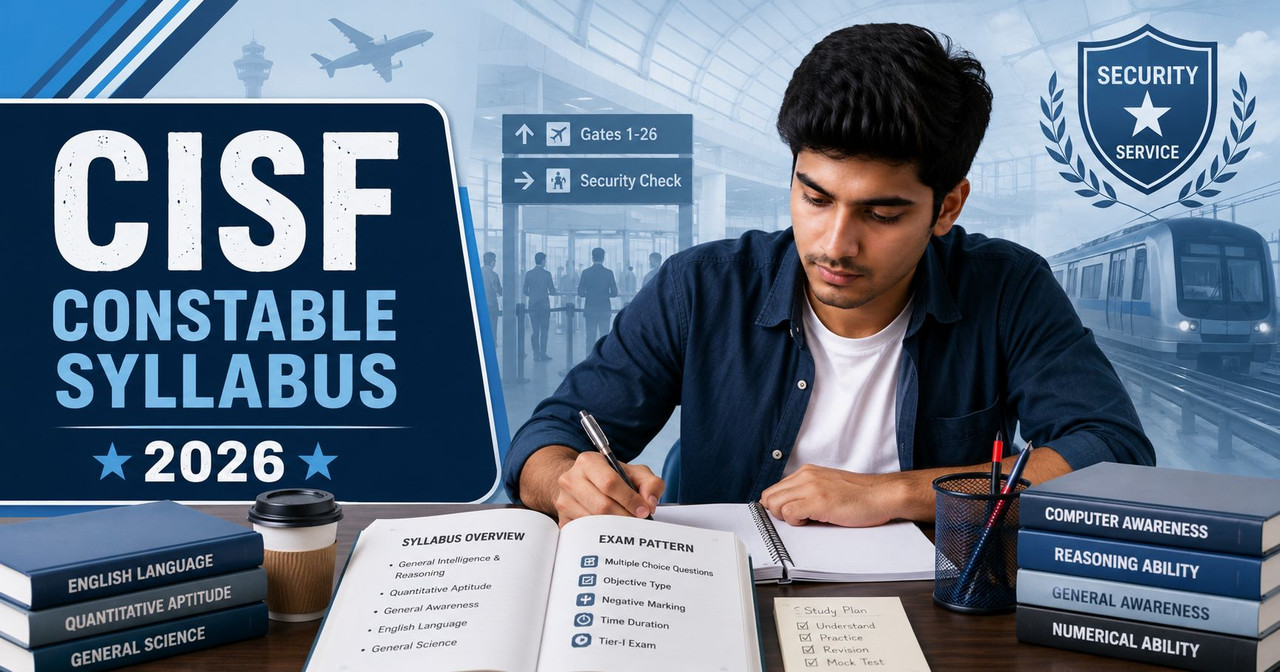
CISF Constable Syllabus 2026 — Complete Exam Pattern & Subject-Wise Guide
The Central Industrial Security Force (CISF) is one of India's largest Central Armed Police Forces, responsible for securing airports, metro networks, nuclear installations, seaports, and other critical infrastructure across the country. The CISF Constable recruitment — covering both General Duty (GD) Constable and Constable/Tradesman posts — attracts a massive number of applicants every year. This guide breaks down the complete CISF Constable syllabus 2026, exam pattern, physical standards, and a subject-wise topic list to help you build an effective preparation strategy.
CISF Constable recruitment is typically conducted for two main categories: Constable (General Duty), responsible for core security and law-and-order duties, and Constable/Tradesman, which includes trade-specific roles such as Cook, Cobbler, Tailor, Barber, Washerman, Painter, Mason, Plumber, Mali (Gardener), and Welder. While the physical standards and trade-test requirements differ slightly between these categories, the written examination pattern and core syllabus remain broadly similar.
Why CISF Constable Is a Popular Career Choice
CISF offers postings across some of India's most sensitive and prestigious locations, including major international airports, the Delhi Metro, nuclear power plants, and space research facilities. For candidates who have completed their 10th or 12th standard, a Constable position with CISF offers a stable central government job, structured promotion path, defence-style allowances, and the opportunity to serve in a nationally important security role — all of which make it a consistently high-demand recruitment among sarkari naukri aspirants.
CISF Constable Selection Process — Overview
The CISF Constable recruitment process typically includes the following stages, and candidates must clear each one sequentially:
- Physical Standard Test (PST) — height, chest (for male candidates), and weight measurement
- Physical Efficiency Test (PET) — race and, in some recruitment cycles, additional physical tasks
- Written Examination — objective-type test covering the prescribed syllabus
- Documentation and Trade Test — for Tradesman posts, a practical skill/trade test is conducted
- Medical Examination — a detailed medical fitness check
- Final Merit List
Only candidates who clear the PST and PET are permitted to sit for the written examination, so physical preparation should begin well ahead of the recruitment cycle.
CISF Constable Physical Standard Test (PST)
CISF prescribes minimum height, chest, and weight standards for male and female candidates, with relaxations available for Scheduled Tribe candidates and residents of specified hill regions as per government norms. Candidates should always check the exact PST requirements in the official notification for the specific recruitment year, as standards can be revised.
CISF Constable Physical Efficiency Test (PET)
The PET evaluates a candidate's basic fitness through timed activities such as a race, and in some cycles additional tasks like long jump or high jump. As with most paramilitary recruitments, candidates who fail to meet the PET benchmark are eliminated regardless of their academic score, so physical training should run parallel to written exam preparation, not after it.
CISF Constable Written Exam Pattern 2026
The written examination for CISF Constable is conducted in objective, multiple-choice format. Based on recent recruitment cycles, the general pattern is as follows:
- Total Questions: 100
- Total Marks: 100 (each question generally carries 1 mark)
- Duration: 2 hours
- Negative Marking: Varies by recruitment cycle — some notifications have specified 0.25 marks deducted per wrong answer, while others have had no negative marking; candidates must confirm this from the official notification for the current exam
- Number of Subjects: 4–5, covering General Awareness/General Knowledge, Elementary Mathematics, Analytical Aptitude and Reasoning, and General English/Hindi
Because the exact marking scheme and negative marking policy have varied between CISF recruitment cycles, candidates should always treat the current notification as the final word rather than relying solely on past patterns.
CISF Constable Syllabus — Subject Wise
1. General Awareness / General Knowledge
- Current Affairs — National and International
- Indian History, Freedom Struggle
- Indian Geography
- Indian Polity and Constitution
- Indian Economy
- General Science (Physics, Chemistry, Biology basics)
- Sports and Games
- Important Days, Awards and Honours
- Books and Authors
- Static GK related to India's defence and security forces
2. Elementary Mathematics
- Number Systems
- Fundamental Arithmetical Operations
- Fractions and Decimals
- Ratio and Proportion
- Percentages
- Averages
- Simple and Compound Interest
- Profit and Loss
- Discount
- Mensuration (Area, Volume, Perimeter)
- Time and Work
- Time and Distance
- Use of Tables and Graphs
3. Analytical Aptitude and Reasoning
- Analogies
- Similarities and Differences
- Spatial Visualisation and Orientation
- Problem Solving and Analysis
- Judgement and Decision Making
- Visual Memory
- Discrimination and Observation
- Relationship Concepts
- Arithmetical Reasoning
- Coding-Decoding
- Verbal and Non-Verbal Series
- Statement and Conclusion
4. General English / Hindi
English:
- Grammar Fundamentals (Tenses, Articles, Prepositions)
- Synonyms and Antonyms
- One-Word Substitution
- Sentence Correction and Improvement
- Idioms and Phrases
- Comprehension Passage
- Spotting Errors
Hindi:
- व्याकरण के मूल सिद्धांत
- पर्यायवाची एवं विलोम शब्द
- मुहावरे एवं लोकोक्तियाँ
- वाक्य शुद्धि
- रिक्त स्थान पूर्ति
- अपठित गद्यांश
5. Trade-Specific Test (for Constable/Tradesman posts only)
Candidates applying for Tradesman posts such as Cook, Tailor, Barber, Cobbler, Washerman, Painter, Mason, Plumber, Mali, and Welder are required to clear a practical trade test in addition to the written exam. This is typically a skill demonstration relevant to the specific trade applied for and is conducted after the written exam and physical tests are cleared.
CISF Constable (GD) vs Constable/Tradesman — Key Differences
| Aspect | Constable (GD) | Constable/Tradesman |
|---|---|---|
| Core Role | General security duties | Trade-specific support roles |
| Written Exam Subjects | GK, Maths, Reasoning, English/Hindi | Same core subjects |
| Additional Test | None (beyond PST/PET) | Practical trade test |
| Eligibility | 10th pass (typically) | 8th/10th pass depending on trade |
| Physical Standards | Standard CISF norms | Standard CISF norms, may vary slightly by trade |
CISF Constable Salary and Benefits
CISF Constables are placed under the applicable Pay Level of the 7th Pay Commission for Central Armed Police Forces, with a starting basic pay generally in the range of ₹21,700 to ₹69,100 per month depending on the specific post and pay matrix level applicable at the time of recruitment. In addition to basic pay, selected candidates receive Dearness Allowance, House Rent Allowance where applicable, Transport Allowance, Ration Money Allowance, and other CAPF-specific benefits such as free medical treatment for self and dependents, canteen facilities, and pension benefits under the applicable government scheme.
How to Prepare for CISF Constable Exam 2026
- Study the official syllabus first — always verify subject weightage and marking scheme against the latest CISF notification once it is released on the official website.
- Divide your preparation by subject — allocate consistent daily time to General Awareness, Mathematics, Reasoning, and English/Hindi rather than over-focusing on one area.
- Prioritise current affairs — General Awareness is a high-scoring section if prepared consistently with a monthly current affairs routine.
- Practice previous year question papers — this helps you understand the actual difficulty level and question style used by CISF.
- Take timed mock tests — since the exam has a strict 2-hour window for 100 questions, speed and time management matter as much as accuracy.
- Start physical training early — the PST/PET stage eliminates a significant number of candidates each year; begin running and fitness practice at least 2-3 months in advance.
- Tradesman applicants should practice their trade skill — since the trade test is practical, hands-on practice is as important as written preparation.
Frequently Asked Questions
Is there negative marking in the CISF Constable exam? This has varied by recruitment cycle — some notifications specify 0.25 marks deducted per wrong answer, while others have had no negative marking. Always confirm this from the current official notification.
How many questions are asked in the CISF Constable written exam? Typically 100 objective-type questions, generally carrying 1 mark each, for a total of 100 marks.
What is the exam duration for CISF Constable? Generally 2 hours, though candidates should confirm the exact duration for the current recruitment cycle.
Do Tradesman applicants need to prepare differently from GD Constable applicants? The written exam syllabus is largely the same, but Tradesman applicants must also prepare for a practical trade-specific skill test after clearing the written exam and physical tests.
Candidates preparing for CISF Constable 2026 recruitment should use this guide as a strong starting foundation, while always cross-checking the final exam pattern, marking scheme, and physical standards against the official CISF notification once released, since minor variations between recruitment cycles are common.
Get Instant Government Job Alerts
Never miss a notification, admit card, or result. Join our free channels for daily sarkari naukri updates delivered straight to your phone:
- 💬 WhatsApp Channel: Join Now
- 📢 Telegram Channel: Join @govtjobsiojobs


Leave a Reply
Be the first to comment.