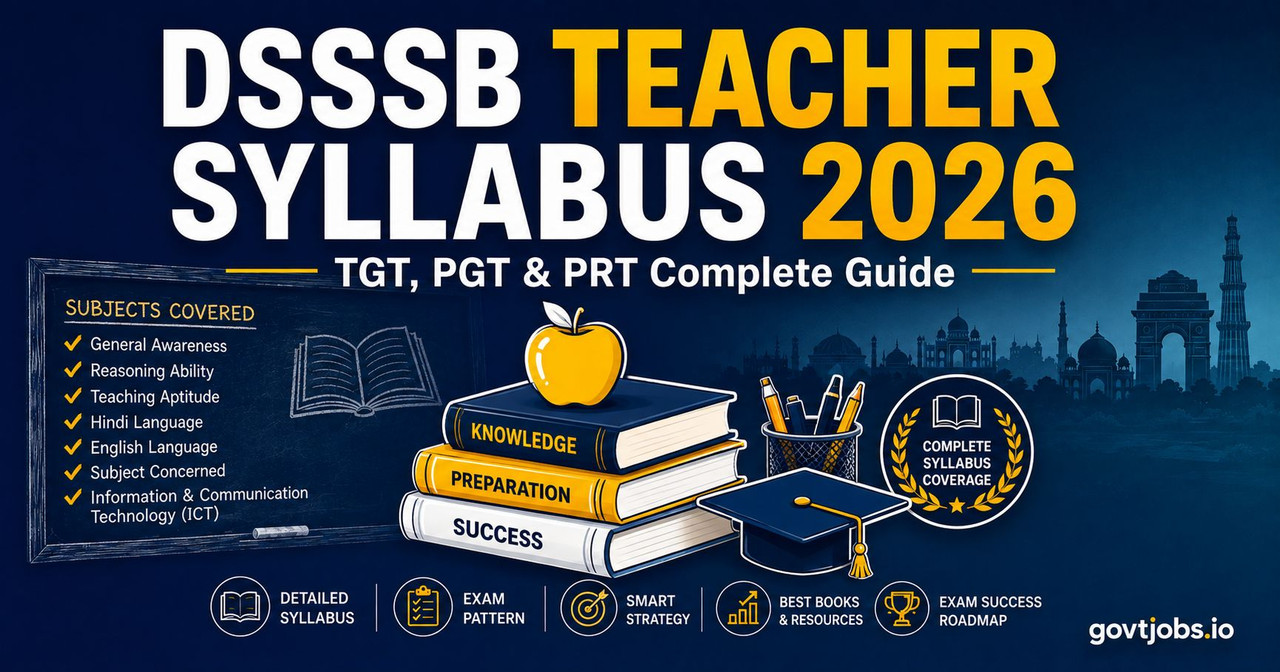
The Delhi Subordinate Services Selection Board (DSSSB) conducts recruitment for teaching posts — Trained Graduate Teacher (TGT), Post Graduate Teacher (PGT), and Primary Teacher (PRT/NTT) — across schools under the Directorate of Education, Government of NCT of Delhi, and the Municipal Corporation of Delhi (MCD). DSSSB teaching jobs are consistently among the most competitive government teaching exams in India, given the large number of applicants for a limited number of Delhi-based vacancies. This guide covers the complete DSSSB Teacher syllabus for 2026, the exam pattern for TGT and PGT posts, marking scheme, and a practical preparation strategy for aspirants targeting a teaching career in Delhi's government school system.
DSSSB was established under the Delhi Subordinate Services Selection Board Act to conduct recruitment examinations for Group B and Group C posts across various departments of the Government of NCT of Delhi and associated local bodies, including the Municipal Corporation of Delhi, the New Delhi Municipal Council, and several Delhi government undertakings. Teaching posts form one of the largest and most closely watched categories of DSSSB recruitment, given the scale of Delhi's government school network, which serves several million students across the National Capital Territory. Understanding this institutional structure helps candidates appreciate why DSSSB releases separate advertisements for different post codes and subject combinations rather than a single consolidated teacher recruitment notification — each vacancy category is tied to specific budgetary sanctions and staffing requirements determined by the Directorate of Education or MCD Education Department for that particular cycle.
DSSSB recruits teachers specifically for Delhi's government and municipal school network, which means candidates preparing for this exam should also familiarise themselves with Delhi-specific educational context, since General Awareness sections in DSSSB papers frequently include questions related to Delhi's history, governance structure, and current civic affairs, distinguishing this exam from more generically national teaching exams like CTET or KVS.
DSSSB TGT Exam Pattern 2026
The DSSSB TGT exam follows a One-Tier (Teaching) examination format for most subjects.
- Total 200 Multiple Choice Questions (MCQs) for 200 marks
- Total duration of 2 hours (120 minutes)
- Negative marking of 0.25 marks for every wrong answer
- The paper is divided into two sections:
- Section A (100 marks): General Awareness, Reasoning, Numerical Ability, English Language, and Hindi Language — approximately 20 marks per sub-area
- Section B (100 marks): Subject-specific content in the candidate's chosen teaching subject, along with Teaching Methodology and B.Ed.-related pedagogy topics
- Candidates must meet minimum qualifying marks in both Section A and Section B separately, based on their category, and final merit is based on aggregate marks across both sections
DSSSB PGT Exam Pattern 2026
Unlike TGT, DSSSB PGT recruitment follows a Two-Tier examination structure:
- Tier 1 is an objective-type screening exam, common in structure to the TGT pattern, covering General Awareness, Reasoning, Numerical Ability, English, and Hindi
- Tier 2 consists of both Objective and Descriptive components, testing in-depth subject knowledge appropriate for senior secondary (Classes 11-12) teaching, along with pedagogy and teaching methodology specific to the subject
- Tier 1 is generally used as a qualifying/screening stage, while Tier 2 carries the primary weight in determining final merit
Candidates should always verify the exact tier structure and marks distribution for their specific post code from the official DSSSB notification, since the board has periodically revised this structure across different recruitment cycles.
DSSSB Section A Syllabus (Common for TGT and Tier 1 for PGT)
General Awareness
- Current Affairs — national, international, and Delhi-specific
- Indian History, Geography, and Polity
- Indian Economy and Government Schemes
- Sports, Awards, Books & Authors
- Science and Technology developments
- Static General Knowledge
Reasoning Ability
- Analogy, Classification, Series Completion
- Coding-Decoding, Blood Relations, Direction Sense
- Non-Verbal Reasoning: Figure series, pattern completion
- Statement-based reasoning, Syllogisms
- Logical and Analytical Reasoning
Numerical Ability
- Number System, Simplification, Percentage
- Profit and Loss, Simple and Compound Interest
- Ratio and Proportion, Time and Work, Time and Distance
- Average, Mensuration, Data Interpretation
English Language
- Grammar: Tenses, Articles, Prepositions, Voice, Narration
- Vocabulary: Synonyms, Antonyms, One-Word Substitution
- Reading Comprehension
- Sentence Correction and Error Spotting
Hindi Language
- हिंदी व्याकरण (संधि, समास, कारक, विलोम शब्द)
- पर्यायवाची शब्द, मुहावरे और लोकोक्तियाँ
- अपठित गद्यांश
- वाक्य शुद्धि
DSSSB Section B / Tier 2 Syllabus (Subject-Specific)
DSSSB TGT and PGT recruitment covers a wide range of subjects, including Mathematics, English, Hindi, Sanskrit, Urdu, Punjabi, Social Science, Science, Drawing, Physical Education, and Special Education. The Section B/Tier 2 syllabus for each subject is structured around two components:
1. Core Subject Knowledge
Based on the NCERT curriculum for the relevant class range — Classes 6 to 10 for TGT subjects, and Classes 11-12 for PGT subjects — covering the complete academic content expected of a subject teacher at that level.
2. Teaching Methodology and Pedagogy (B.Ed.-based topics)
- Child Development and Learning Theories: Piaget, Vygotsky, Bloom's Taxonomy
- Inclusive Education and understanding diverse learners
- Assessment Methods: Formative and Summative evaluation
- Curriculum Development principles
- Mathematics Pedagogy: teaching methods for arithmetic, problem-solving approaches at appropriate levels (for Mathematics candidates)
- Language Development: first and second language acquisition, teaching reading and writing, grammar teaching approaches (for Language candidates)
- Science Pedagogy: laboratory methods, experiential learning approaches for Science subjects
- Social Science Pedagogy: methods of teaching History, Geography, and Civics, use of primary and secondary sources
Since Tier 2/Section B is where the majority of marks are decided, subject mastery combined with strong pedagogy knowledge is non-negotiable for DSSSB teaching candidates — a TGT Mathematics candidate, for instance, will face a full set of Mathematics-education-focused questions in Tier 2/Section B, not general aptitude questions.
DSSSB Teaching Posts Covered
DSSSB conducts recruitment across several distinct teaching categories, each with its own eligibility criteria and exam structure:
- DSSSB TGT (all subjects): Vacancies for Directorate of Education (Delhi Government) and MCD Delhi schools
- DSSSB PGT: For senior secondary school teaching positions across Delhi government schools
- DSSSB PRT/NTT: For primary and nursery-level teaching in Delhi government and MCD schools
- DSSSB Special Education Teacher: For teaching children with special needs, requiring a specialised B.Ed. (Special Education) qualification
Candidates should also understand the practical difference between applying for a Directorate of Education (DoE) post versus an MCD post, since both employ TGT, PGT, and PRT teachers under broadly similar DSSSB-administered exams, but with some differences in service conditions, posting locations, and administrative reporting structure. DoE schools are generally larger secondary and senior secondary institutions spread across all districts of Delhi, while MCD schools historically focus more heavily on primary and upper primary education, though this has evolved over recent years. Candidates should read the specific advertisement carefully to understand which department they are applying under, since this affects long-term career progression, transfer policies, and promotional avenues within the Delhi government teaching cadre, even though the entry-level exam pattern and syllabus remain largely similar across both employing departments.
Beyond teaching posts, DSSSB also conducts recruitment for a wide range of non-teaching government positions in Delhi, including Junior Engineer (Civil/Electrical), Pharmacist, Patwari, and Lower Division Clerk roles, though these follow different syllabi from the teaching posts covered in this guide.
DSSSB Selection Process
- For TGT posts: Written examination (One-Tier) followed by document verification. There is no separate interview for most TGT subjects.
- For PGT posts: Tier 1 screening, followed by Tier 2 (Objective + Descriptive), followed by document verification.
- For PRT/NTT posts: Similar One-Tier written examination structure to TGT, adapted for primary-level pedagogy content.
Candidates should note that DSSSB has periodically revised whether an interview is included in the final selection stage for certain posts, so this should always be confirmed from the specific recruitment notification rather than assumed based on previous cycles.
Why DSSSB Exams Are Highly Competitive
DSSSB teaching posts attract an exceptionally large applicant pool relative to the number of vacancies, for several structural reasons. Delhi government schools are widely regarded as offering strong infrastructure, competitive pay, and a stable long-term career compared to many state government school systems, which draws applicants not just from Delhi but from across northern India. Additionally, because DSSSB conducts recruitment for a fixed geographic area (Delhi NCT) rather than an entire state, the number of schools and corresponding vacancies per cycle is inherently smaller than, say, a large state's TET-based recruitment, while the applicant pool remains proportionally just as large or larger. This combination of high demand and limited seats makes DSSSB negative marking (0.25 per wrong answer) a genuinely important factor in candidates' scoring strategy — careless guessing can meaningfully damage a candidate's competitive position given how tightly bunched final cut-offs tend to be.
A distinguishing feature of DSSSB recruitment compared to many other state teaching exams is the relatively frequent cycle of notifications for specific subjects or post codes, rather than one large annual consolidated drive. This means candidates preparing for DSSSB TGT or PGT should treat their preparation as an ongoing process rather than something to compress into the weeks immediately following a single annual notification, since a new advertisement for their specific subject may appear multiple times within a year depending on vacancy availability. Maintaining exam readiness year-round through regular revision and periodic mock tests puts candidates in a stronger position to respond quickly whenever a fresh DSSSB notification for their subject and post code is released, rather than needing to restart preparation from scratch each time.
DSSSB Teacher Preparation Strategy
- Build strong fundamentals in Section A (General Awareness, Reasoning, Numerical Ability, English, Hindi) early, since this section is common across most TGT subjects and PGT Tier 1
- For Section B/Tier 2, focus preparation squarely on NCERT textbooks for your subject and class range, since DSSSB draws heavily from this curriculum
- Dedicate specific study time to teaching methodology and B.Ed.-level pedagogy content — many candidates with strong subject knowledge underperform here simply because they treat it as a lower priority
- Since there is negative marking of 0.25 per wrong answer, avoid blind guessing; use the elimination method and only attempt questions where you can rule out at least two incorrect options
- Stay current on Delhi-specific general awareness, including Delhi government schemes, Delhi's civic administration structure, and recent Delhi-related current affairs, since this is a distinguishing feature of DSSSB's General Awareness section compared to other teaching exams
- Practice previous years' DSSSB question papers extensively, since question patterns and subject weightage within Section B tend to be fairly consistent across cycles for the same post code
- For PGT aspirants, treat Tier 1 seriously even though it is a screening stage — a weak Tier 1 performance can eliminate strong candidates before they even reach the subject-heavy Tier 2 where their real strength lies
Given the volume of applicants, DSSSB has increasingly moved toward large-scale computer-based testing infrastructure for its written examinations, though candidates should always confirm the exact mode (online CBT or offline OMR) specified in their specific admit card, since this can occasionally vary by exam cycle and post category. Familiarising yourself with the computer-based test interface through official mock test links provided by DSSSB before your actual exam date is a small but genuinely useful preparation step that reduces the chance of losing time to unfamiliar navigation or answer-marking procedures on the actual exam day — particularly important given the tight per-question time budget across 200 questions in 120 minutes. These practical exam day considerations matter as much as subject preparation itself when competing in an exam this tightly contested.
Frequently Asked Questions
Is DSSSB TGT a one-tier or two-tier exam? DSSSB TGT is a One-Tier examination consisting of 200 MCQs for 200 marks, completed in 2 hours.
Is there negative marking in DSSSB exams? Yes, there is a negative marking of 0.25 marks for every incorrect answer in both TGT and PGT examinations.
How is DSSSB PGT different from TGT in exam structure? DSSSB PGT follows a Two-Tier structure — an objective Tier 1 screening exam followed by a Tier 2 exam with both Objective and Descriptive components, unlike TGT's single-tier format.
Do candidates need to qualify Section A and Section B separately for TGT? Yes, candidates must meet minimum qualifying marks in both Section A and Section B separately, based on their category, before final merit is calculated on aggregate marks.
Is DSSSB syllabus the same for all subjects? No, the general subjects in Section A/Tier 1 remain common across posts, but the subject-specific Section B/Tier 2 content varies according to the teaching subject and post applied for.
Does DSSSB include current affairs in its syllabus? Yes, current affairs is included within the General Awareness section, covering national, international, and Delhi-specific events.
Can NCERT books be used for DSSSB preparation? Yes, NCERT textbooks are highly recommended for DSSSB teaching post preparation, since the subject-specific syllabus for TGT and PGT posts closely follows the NCERT curriculum for the relevant class range.
Get Instant Government Job Alerts
Never miss a notification, admit card, or result. Join our free channels for daily sarkari naukri updates delivered straight to your phone:
- 💬 WhatsApp Channel: Join Now
- 📢 Telegram Channel: Join @govtjobsiojobs




Leave a Reply
Be the first to comment.