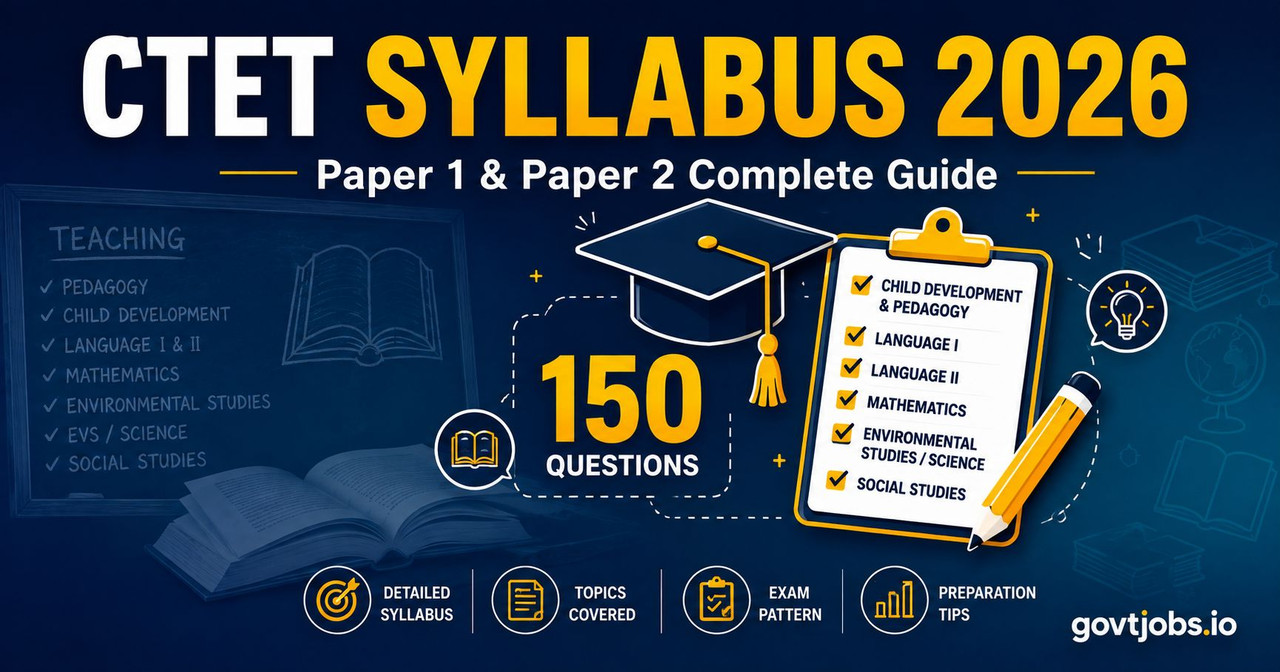
The Central Teacher Eligibility Test (CTET) 2026, conducted by the Central Board of Secondary Education (CBSE), is the mandatory eligibility exam for candidates who want to teach in central government schools like Kendriya Vidyalayas, Navodaya Vidyalayas, and other CBSE-affiliated institutions across India. Understanding the CTET syllabus thoroughly is the first step for anyone preparing for this teaching eligibility test, since the exam covers two separate papers with distinct subject requirements depending on whether you want to teach primary classes or upper primary classes. This guide covers the complete CTET syllabus for both Paper 1 and Paper 2, the exam pattern, marking scheme, and a practical preparation strategy for CTET aspirants.
CTET Exam Pattern 2026
CTET consists of two papers, and candidates may appear for one or both depending on the teaching level they are targeting.
- Paper 1 is for candidates who want to teach Classes 1 to 5 (Primary Stage)
- Paper 2 is for candidates who want to teach Classes 6 to 8 (Upper Primary Stage)
- Candidates aiming to teach both primary and upper primary levels must appear for both papers
- Both papers consist of 150 objective-type Multiple Choice Questions (MCQs) carrying 150 marks
- Each paper has a duration of 150 minutes (2.5 hours)
- The exam is conducted in offline, pen-and-paper mode using OMR sheets
- There is no negative marking for incorrect answers in CTET
- Qualifying marks are 60% for General category candidates and 55% for reserved category candidates
- CTET certificates, once qualified, are valid for a lifetime
Understanding why each section of CTET carries the weight it does helps candidates allocate study time more effectively. Child Development and Pedagogy alone accounts for 20% of the total marks in both papers, making it the single most important section for candidates who master the underlying theory, since these questions test conceptual understanding rather than rote memorisation and therefore reward candidates who genuinely understand developmental psychology over those who simply memorise definitions. The two Language sections together account for 40% of Paper 1 and Paper 2 marks, reflecting how heavily CTET weighs communication and language pedagogy skills for prospective teachers, since a teacher who cannot effectively teach language and comprehension skills to young children is considered less prepared for the classroom regardless of subject expertise elsewhere.
CTET Paper 1 Syllabus (Classes 1 to 5)
CTET Paper 1 is divided into 5 sections, each carrying 30 questions for 30 marks.
1. Child Development and Pedagogy (30 Questions, 30 Marks)
This is one of the most scoring sections if prepared well, and covers:
- Concept of development and its relationship with learning
- Principles of child development
- Influence of Heredity and Environment
- Socialization processes: Social World and children (Teacher, Parents, Peers)
- Piaget, Kohlberg, and Vygotsky: constructs and critical perspectives
- Concepts of child-centered and progressive education
- Critical perspective of the construct of Intelligence
- Multi-dimensional Intelligence and Multiple Intelligence theory
- Language and Thought
- Gender as a social construct; gender roles, gender bias, and educational practice
- Individual differences among learners, understanding differences based on diversity of language, caste, gender, community, religion
- Distinction between assessment for learning and assessment of learning
- Formative and Summative assessment
- Concept of inclusive education and understanding children with special needs
- Addressing the needs of children with learning difficulties, impairment, and gifted, disabled, and mentally challenged learners
- Understanding children from disadvantaged and deprived backgrounds
2. Language I (30 Questions, 30 Marks)
Tests proficiency in the medium of instruction chosen by the candidate:
- Reading Unseen Passage (prose/drama/poem) with questions on comprehension, inference, grammar, and verbal ability
- Pedagogy of Language Development: learning and acquisition, principles of language teaching
- Role of listening and speaking in language acquisition and language skill development
- Critical perspective on the role of grammar in learning a language for communicative purposes
- Challenges of teaching language in a diverse classroom
- Language skills, evaluating language comprehension and proficiency
- Teaching-learning materials: textbook, multimedia materials, multilingual resources
- Remedial teaching
3. Language II (30 Questions, 30 Marks)
Language II is different from Language I and follows a similar structure — reading comprehension, pedagogy of language development, and language skills.
4. Mathematics (30 Questions, 30 Marks)
- Geometry, Shapes and Spatial Understanding, Solids around Us
- Numbers, Addition and Subtraction, Multiplication, Division
- Measurement, Weight, Time, Volume, Data Handling, Patterns, Money
- Pedagogical issues: nature of Mathematics/Logical thinking, place of Mathematics in the curriculum
- Language of Mathematics, community mathematics
- Evaluation through formal and informal methods
- Problems of teaching, error analysis, and related aspects of teaching-learning
- Diagnostic and remedial teaching
5. Environmental Studies (30 Questions, 30 Marks)
- Family and Friends: Relationships, Work and Play, Animals, Plants
- Food, Shelter, Water, Travel, Things We Make and Do
- Concept and scope of EVS, significance of EVS, integrated EVS
- Environmental Studies and Environmental Education
- Learning Principles, Scope and relation to Science and Social Science
- Approaches of presenting concepts, activities, experimentation/practical work
- CCE (Continuous and Comprehensive Evaluation), teaching material/aids
- Problems
CTET Paper 2 Syllabus (Classes 6 to 8)
CTET Paper 2 is divided into 4 sections. Candidates must choose between Mathematics & Science and Social Studies for the fourth section.
1. Child Development and Pedagogy (30 Questions, 30 Marks)
Identical in structure to Paper 1's Child Development section, though the focus shifts more toward the upper primary developmental stage (ages 11–14).
2. Language I (30 Questions, 30 Marks) and Language II (30 Questions, 30 Marks)
Same structure as Paper 1's language sections, but questions are pitched at a slightly higher level of language proficiency appropriate for Classes 6-8.
3. Mathematics and Science (60 Questions, 60 Marks) — for Mathematics/Science teachers
Mathematics topics: Number System, Algebra, Geometry, Mensuration, Data Handling, Pedagogical issues including nature of Mathematics, place of Mathematics in curriculum, language of Mathematics, community Mathematics, evaluation, error analysis, and remedial teaching.
Science topics: Food, Materials, The World of the Living, Moving Things, People and Ideas, How Things Work, Natural Phenomena, Natural Resources, Pedagogical issues including nature and structure of Science, natural science and formal science, understanding and appreciating science, approaches, integrated approach, place of Science in the curriculum, evaluation, and remedial teaching.
4. Social Studies/Social Science (60 Questions, 60 Marks) — for Social Studies teachers
History: When, Where, and How; Earliest Societies; Empire; New Ideas; Buildings, Paintings, and Books; Ways of Living; The Making of Regional Cultures; Eighteenth-Century Political Formations; the British Empire, Rural Life and Society; Colonialism and Tribal Societies; the Freedom Struggle; Understanding Independent India.
Geography: Geography as a social study and integrated study; Earth as our habitat; Resources; Agriculture; India: Land and People.
Social and Political Life: Diversity; Government; Local Government; Making a Living; Democracy; State Government; Understanding Media; Unpacking Gender; the Constitution; Parliamentary Government; the Judiciary; Social Justice and the Marginalised.
Pedagogical issues: Concept and Nature of Social Science/Social Studies, Class Room Processes, activities and discussion, Developing Critical thinking, Enquiry/Empirical Evidence, Problems of teaching Social Science/Social Studies, sources – primary and secondary, Projects Work, Evaluation.
Should You Prepare for Paper 1, Paper 2, or Both?
Candidates often ask whether to prepare for Paper 1, Paper 2, or both together. While it is possible to prepare for both simultaneously given the overlapping Child Development and Language sections, candidates with a clear career goal — such as wanting to teach only primary classes or only upper primary classes — should focus their preparation time on the specific paper relevant to their goal, since Mathematics, Science, and Social Studies content in Paper 2 requires meaningfully deeper subject knowledge than the corresponding EVS section in Paper 1. Candidates who clear only Paper 1 remain eligible to teach Classes 1 to 5, while those who clear only Paper 2 remain eligible for Classes 6 to 8. Clearing both significantly widens the range of teaching positions a candidate becomes eligible for, including KVS PRT, KVS TGT, DSSSB PRT, and various State TET-equivalent postings.
CTET vs State TET
CTET is not the only teacher eligibility test in India — most states conduct their own State TET based on a broadly similar syllabus and pattern to CTET, though the exact weightage and regional language requirements differ. CTET-qualified candidates are eligible to apply for teaching positions in central government schools across India regardless of which state they are from, making it the more broadly useful qualification for candidates open to relocating for a central government teaching job. Many states also accept a valid CTET qualification as equivalent to their own State TET for recruitment to state government schools, though candidates should always verify this state-specific equivalence rule directly from the relevant state education department before assuming eligibility.
CTET Exam Date and Important Dates 2026
CTET 2026 is scheduled to be conducted on 6 September 2026. Candidates should regularly check the official website ctet.nic.in for updates on notification, application dates, admit card release, and exam city intimation slips.
A Realistic CTET Preparation Timeline
A realistic CTET preparation timeline for a candidate starting from scratch typically spans four to six months. Begin with a diagnostic assessment of your existing knowledge across all five or four sections depending on which paper you are targeting, then allocate the first six to eight weeks to building foundational understanding of Child Development and Pedagogy theory, since this conceptual base also supports your understanding of pedagogy questions embedded within the Language, Mathematics, and EVS sections. Spend the middle phase of your preparation working systematically through NCERT textbook content for your chosen subjects, reading each chapter actively and making short notes rather than passively re-reading. In the final four to six weeks before the exam, shift focus almost entirely to previous year question papers and full-length mock tests under timed conditions, since time management across 150 questions in 150 minutes is itself a skill that improves significantly with repeated practice.
How to Prepare for CTET Effectively
- Base your preparation on NCERT textbooks from Classes 1 to 8, since the CTET syllabus is closely aligned with the NCERT curriculum
- Give equal weightage to Child Development and Pedagogy — this section carries 30 marks and is highly scoring for candidates who understand the theoretical frameworks of Piaget, Vygotsky, and Kohlberg
- Solve previous years' CTET question papers to understand the exact difficulty level and question pattern
- Take regular mock tests to build speed, since you need to attempt 150 questions in 150 minutes
- Focus on NCF 2005 and NEP 2020 guidelines, as pedagogy questions increasingly draw from these policy documents
- Revise Language pedagogy concepts separately from grammar, since CTET tests both comprehension and teaching methodology
- Since there is no negative marking, attempt all 150 questions rather than leaving any blank
A common mistake among first-time CTET candidates is under-preparing for the pedagogy-heavy portions embedded within subject-specific sections. Mathematics and EVS in Paper 1, for example, do not only test subject content — they also test how well a candidate understands how to teach that content to young children, including common misconceptions children have, error analysis of typical student mistakes, and appropriate remedial teaching strategies. Candidates who prepare only the subject content while ignoring the pedagogical dimension often find themselves unable to answer a meaningful portion of questions in each subject section, even when they know the underlying content well. Practising previous year papers specifically to identify this pedagogy-versus-content split within each section is one of the most effective ways to close this gap before exam day.
What Comes After Clearing CTET?
After clearing CTET, candidates become eligible to apply for a wide range of central government teaching positions, including Kendriya Vidyalaya Sangathan (KVS) Primary Teacher (PRT) and Trained Graduate Teacher (TGT) posts, Navodaya Vidyalaya Samiti (NVS) teaching posts, and Delhi Subordinate Services Selection Board (DSSSB) teaching posts in Delhi government schools, among others. Since CTET itself is only an eligibility test and not a recruitment exam, candidates must separately apply to and clear the specific recruitment process of whichever organisation they wish to join, meaning CTET should be viewed as the first gate in a longer teaching career pathway rather than the final step. Maintaining a valid CTET score well ahead of specific recruitment notifications gives candidates a meaningful head start, since they can apply immediately when a KVS, DSSSB, or NVS vacancy is announced rather than needing to first qualify CTET under exam-specific time pressure. Keeping this longer career pathway in mind before starting your CTET preparation helps set realistic expectations for the months ahead.
Frequently Asked Questions
Is there negative marking in CTET 2026? No, there is no negative marking in CTET. One mark is awarded for every correct answer, and no marks are deducted for wrong or unattempted questions.
What is the minimum qualifying percentage for CTET? General category candidates need 60% marks to qualify, while SC/ST/OBC and other reserved category candidates need 55% marks.
Can I appear for both Paper 1 and Paper 2 in the same CTET cycle? Yes, candidates who wish to teach both primary and upper primary classes can appear for both papers in the same exam session.
How long is the CTET certificate valid? The CTET qualifying certificate is valid for a lifetime, so once you clear it, you do not need to reappear unless you wish to improve your score.
Which books are best for CTET preparation? NCERT textbooks from Class 1 to Class 8 are considered the most reliable source, since the CTET syllabus is directly based on the NCERT curriculum.
Get Instant Government Job Alerts
Never miss a notification, admit card, or result. Join our free channels for daily sarkari naukri updates delivered straight to your phone:
- 💬 WhatsApp Channel: Join Now
- 📢 Telegram Channel: Join @govtjobsiojobs




Leave a Reply
Be the first to comment.