Introduction
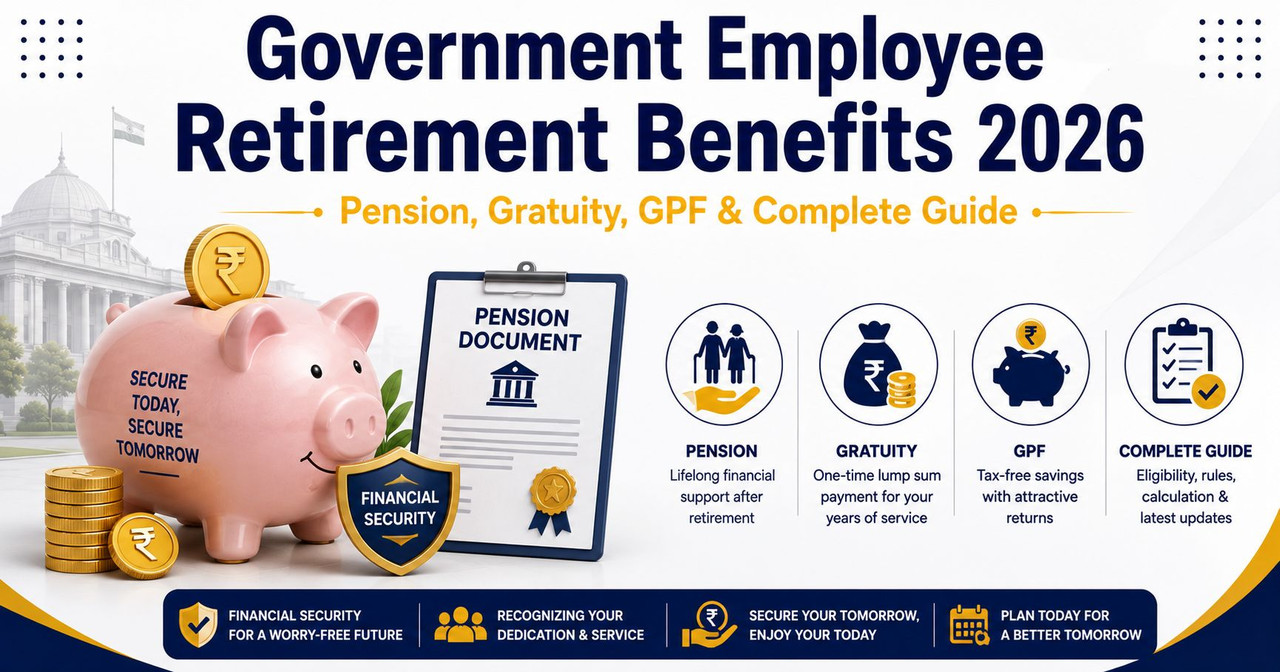
Job security is one of the most cited reasons candidates pursue a government career in India, and a major part of that security comes from the structured retirement benefits available to government employees — benefits that typically far exceed what most private-sector roles offer. This guide covers the complete range of government employee retirement benefits available in 2026, including pension schemes, gratuity, General Provident Fund, leave encashment, and post-retirement medical coverage, so you understand exactly what to expect when planning for the long term.
Retirement benefits for government employees vary somewhat depending on when the employee joined service (pre- or post-2004) and which state or central pension scheme applies to them — this guide breaks down each major benefit category clearly.
1. Pension (NPS / UPS / OPS)
Pension is the cornerstone of government retirement benefits, though the applicable scheme depends on when and where the employee joined:
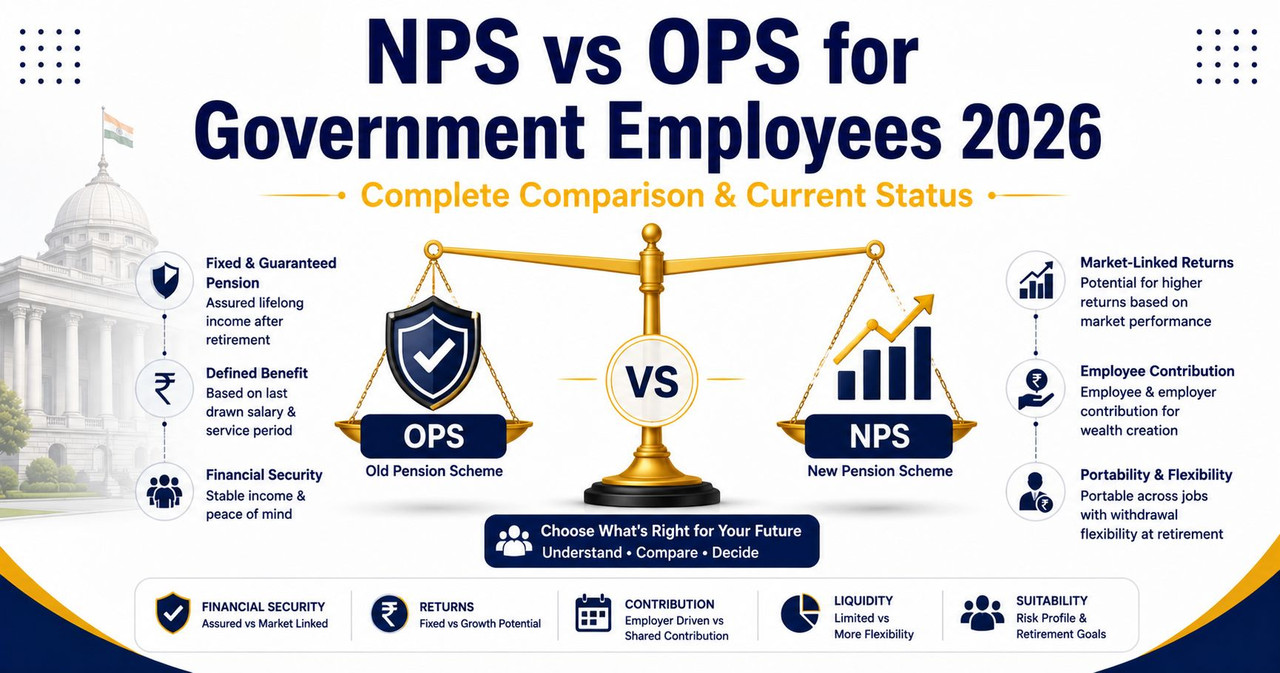
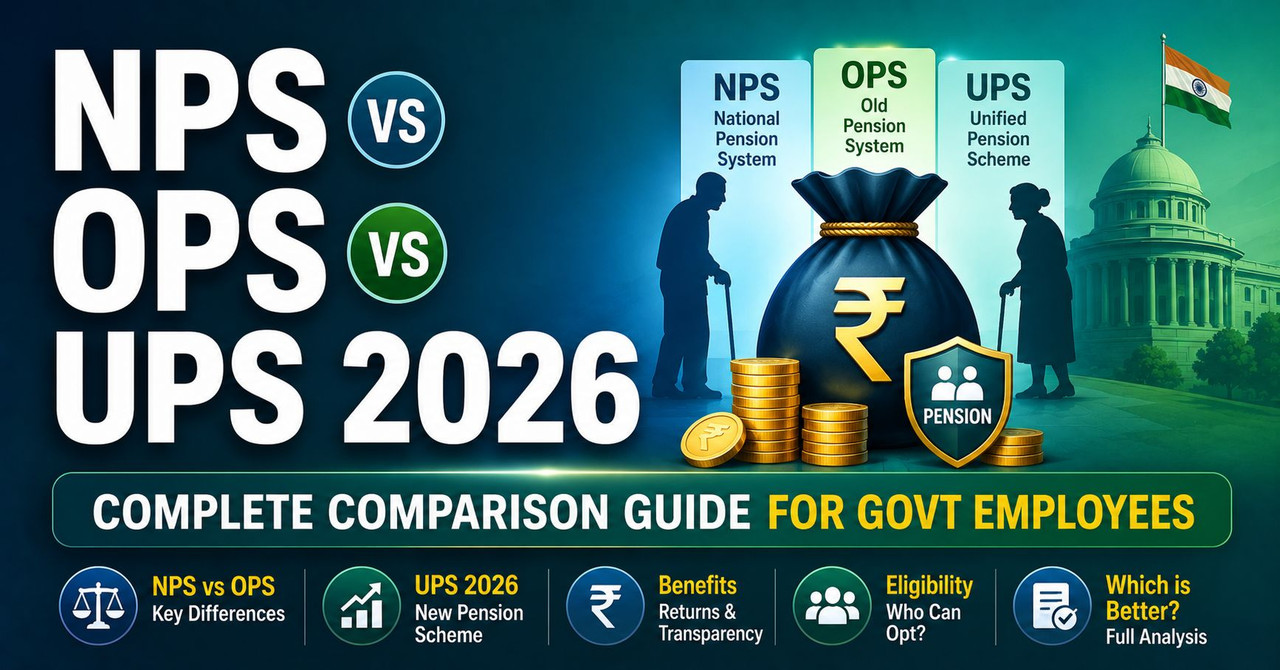
- National Pension System (NPS): The default contributory pension scheme for central government employees who joined service on or after 1 January 2004, and for state government employees in most states that adopted NPS. Under NPS, both employee and employer contribute a percentage of basic pay + DA into a pension fund invested in market-linked instruments, with the accumulated corpus available at retirement (partly as a lump sum, partly as an annuity for regular pension income)
- Unified Pension Scheme (UPS): Introduced as an option under the NPS framework, notified in January 2025 and implemented from 1 April 2025, offering central government employees a choice between NPS and UPS. UPS provides an assured pension of approximately 50% of the average basic pay of the last 12 months of service for employees with 25+ years of qualifying service (proportionate for shorter service), along with a minimum guaranteed pension after 10 years of service and family pension provisions
- Old Pension Scheme (OPS): The pre-2004 non-contributory scheme, under which employees receive a defined pension (50% of last drawn basic pay + DA) without any employee contribution during service, funded entirely by the government. OPS continues to apply only to employees who joined before the relevant cut-off date, and a small number of states have reverted to offering OPS to their government employees — read our detailed NPS vs OPS comparison for state-specific details
2. Gratuity
Gratuity is a lump-sum retirement benefit paid to employees who have completed a minimum qualifying period of service (typically 5 years), calculated based on the employee's last drawn salary and total years of service, under the Payment of Gratuity Act, 1972 (with government-specific rules under the Central Civil Services Pension Rules for central employees). The maximum gratuity ceiling is revised periodically and currently stands at a substantial amount for eligible retiring government employees.
3. General Provident Fund (GPF) / Contributory Provident Fund
For employees under the Old Pension Scheme framework, the General Provident Fund (GPF) is a mandatory savings scheme where a percentage of basic pay is deducted monthly and deposited into the employee's GPF account, earning government-notified interest, with the full accumulated corpus payable at retirement. Employees under NPS instead have their retirement savings primarily routed through the NPS corpus rather than a separate GPF account, though some states maintain parallel provident fund arrangements.
4. Leave Encashment
Government employees accumulate Earned Leave (EL) and, in many cases, Half-Pay Leave (HPL) throughout their service. Upon retirement, unused Earned Leave (up to a specified ceiling, commonly 300 days for central government employees) can be encashed — meaning the employee receives a lump-sum cash payment equivalent to the salary for those accumulated leave days, providing a meaningful additional retirement corpus for employees who didn't fully utilise their annual leave entitlement over their career.
5. Post-Retirement Medical Benefits
Central government retirees are typically eligible for continued medical coverage through schemes like the Central Government Health Scheme (CGHS), or equivalent state-level health schemes for state government retirees, covering the retired employee and eligible dependents for outpatient and hospitalisation care, often at significantly subsidised or covered rates compared to private health insurance.
6. Family Pension
In the event of a government employee's death — whether in service or after retirement — eligible family members (typically spouse, and in specific circumstances, dependent children) are entitled to a family pension, calculated as a percentage of the deceased employee's last drawn pay, ensuring continued financial support for the family.
7. Commutation of Pension
Retiring employees (primarily under OPS-linked or defined-benefit pension structures) have the option to commute (convert) a portion of their monthly pension — typically up to 40% — into an immediate lump-sum payment at the time of retirement, in exchange for a proportionately reduced monthly pension for a specified period (commonly 15 years), after which the full pension amount is restored.
Retirement Age for Government Employees
The standard superannuation (retirement) age for most central government employees is 60 years, though this varies for certain services and categories — some specific posts, judicial services, and defence personnel have different retirement age norms as specified in their respective service rules. State government retirement age policies can also differ from the central norm, so employees should confirm the exact applicable age under their specific state or department's rules.
Planning for Retirement as a Government Employee
- Understand which pension scheme (NPS, UPS, or OPS) applies to you based on your joining date and state, since this fundamentally shapes your retirement income planning
- Track your accumulated Earned Leave balance periodically, since leave encashment forms a meaningful part of your total retirement corpus
- If under NPS, review your fund allocation periodically (where permitted), since the investment mix affects your eventual pension corpus significantly more than under a fixed-benefit scheme like OPS
- Keep your service records, nomination forms, and family details updated throughout your career, since these directly determine family pension and gratuity nominee processing in case of unforeseen circumstances
Get Instant Government Job Alerts
Never miss a notification, admit card, or result. Join our free channels for daily sarkari naukri updates delivered straight to your phone:
- 💬 WhatsApp Channel: Join Now
- 📢 Telegram Channel: Join @govtjobsiojobs

Leave a Reply
Be the first to comment.