Introduction
Few topics generate as much discussion among government employees and aspirants as the NPS vs OPS debate. Which pension scheme applies to you can significantly affect your retirement income planning, and the rules have grown more layered in recent years with the introduction of a third option — the Unified Pension Scheme (UPS). This guide presents a clear, factual comparison of NPS, OPS, and UPS, along with the current state-wise status as of 2026, so you understand exactly where things stand and what applies to your specific situation.
This is a genuinely contested policy area, with the Central Government, various state governments, and employee associations holding different positions — this article presents the facts of each scheme and the current state of play, rather than arguing for one scheme over another.
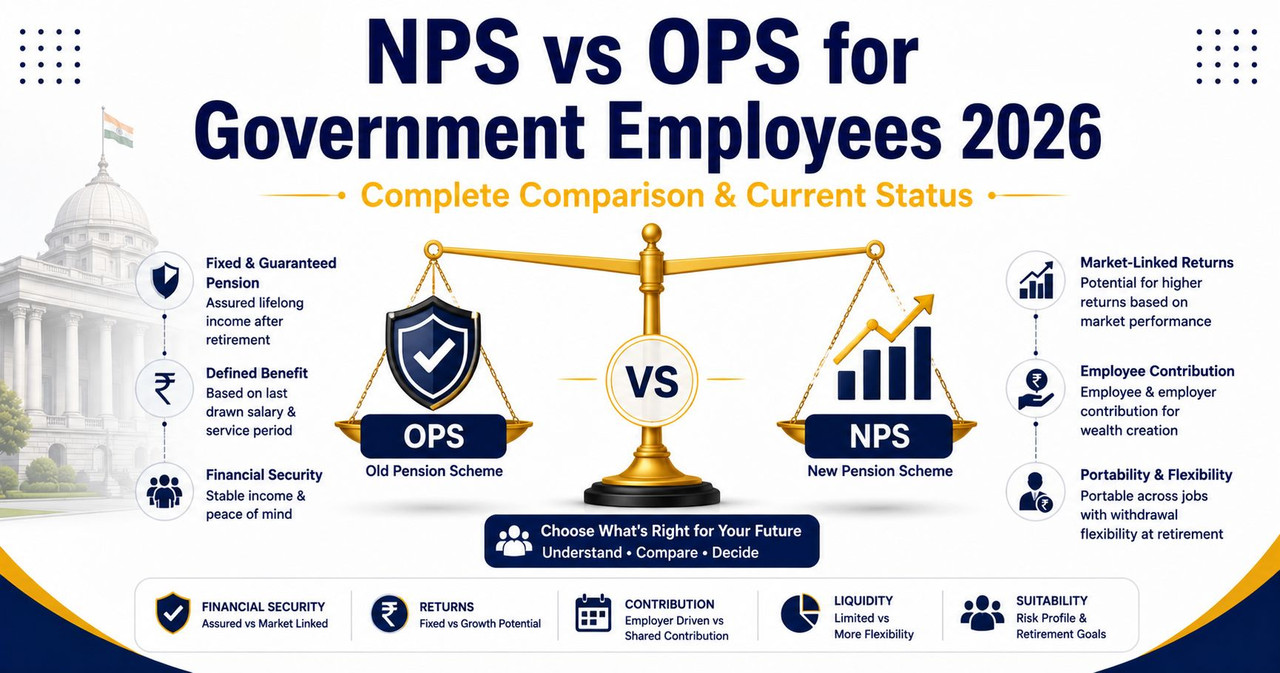
What Is the Old Pension Scheme (OPS)?
OPS was the pension framework applicable to government employees before 1 January 2004. Its key features:
- No employee contribution during service — the entire pension is funded by the government
- Defined benefit: Pension is fixed at 50% of the last drawn basic pay plus Dearness Allowance, regardless of market performance
- Dearness Relief: The pension amount is periodically revised in line with DA hikes given to serving employees, protecting against inflation
- Family pension: Provided to eligible dependents in the event of the pensioner's death
- Commutation option: Retirees can convert up to 40% of their pension into an immediate lump sum, with the balance restored after a specified period
OPS is often described as more financially secure for the individual employee since the payout is guaranteed and inflation-protected, but it places the full funding burden on the government's exchequer, since there's no dedicated corpus built up during the employee's service.
What Is the National Pension System (NPS)?
NPS replaced OPS for new central government recruits from 1 January 2004, and was subsequently adopted by most (though not all) state governments for their own employees. Its key features:
- Contributory: Both the employee (typically 10% of basic pay + DA) and the government/employer (a higher percentage, revised periodically) contribute monthly into an individual pension account
- Market-linked: Contributions are invested in a mix of equity, corporate bonds, and government securities, with the final retirement corpus depending on investment performance over the employee's career
- Partial withdrawal and annuity: At retirement, a portion of the accumulated corpus can be withdrawn as a lump sum, with the remainder mandatorily used to purchase an annuity that provides regular pension income
- Portable: Since it's an individual account-based system, NPS is portable even if an employee changes jobs between different eligible employers
NPS is designed to be more fiscally sustainable for the government over the long term, since the pension liability is funded through the accumulated corpus rather than being paid directly from ongoing government revenue, though it carries market-linked uncertainty around the eventual payout compared to OPS's guaranteed formula.
What Is the Unified Pension Scheme (UPS)?
UPS was introduced by the Central Government as a new option available to central government employees under the NPS framework, notified in January 2025 and implemented from 1 April 2025. It's designed to combine elements of both OPS's payout certainty and NPS's funded structure:
- Assured pension: Approximately 50% of the average basic pay of the last 12 months of service, for employees with a minimum of 25 years of qualifying service (a proportionate amount for shorter qualifying service, down to a minimum service threshold)
- Minimum guaranteed pension: At least ₹10,000 per month after a minimum of 10 years of qualifying service
- Family pension: Approximately 60% of the employee's pension amount, payable to the eligible spouse
- Inflation indexation: The assured pension amount is adjusted in line with Dearness Allowance revisions
- Funded structure: Requires a combined employee and employer contribution (with the employer contribution being notably higher than under standard NPS) to fund the assured payout, maintaining fiscal sustainability while offering greater payout certainty than standard NPS
- Tax benefits: UPS has been extended tax benefits comparable to those available under NPS
Central government employees under NPS were given a window to opt into UPS instead, giving them a choice between the market-linked NPS structure and UPS's more defined, assured-payout structure.
Current State-Wise Status (as of 2026)
The Central Government has been clear that OPS will not be restored for central government employees, citing long-term fiscal sustainability concerns, and has instead offered UPS as its preferred reform path. However, pension policy for state government employees is a state subject, and several states have taken independent decisions:
States that have reverted from NPS to OPS for their own employees: Rajasthan, Chhattisgarh, Jharkhand, Himachal Pradesh, and Punjab have each announced and implemented a reversion to OPS for state government employees at various points in recent years — though the pace and completeness of implementation has varied by state, and this remains a politically active area subject to change with future state government transitions.
States where the demand remains active: In several other states, including Karnataka, employee associations continue to actively campaign for OPS restoration, with state governments in some cases constituting committees to study the matter without yet reaching a final decision.
Central Government employees: Continue under NPS, with UPS available as an additional optional choice since April 2025 — there is no central government proposal currently under consideration to restore OPS for central employees.
This state-by-state variation means the honest answer to "which pension scheme applies to me" depends entirely on which government (central or a specific state) you're employed under, and when you joined service — always confirm your specific applicable scheme through your department's official service rules rather than assuming a national-level answer applies uniformly.
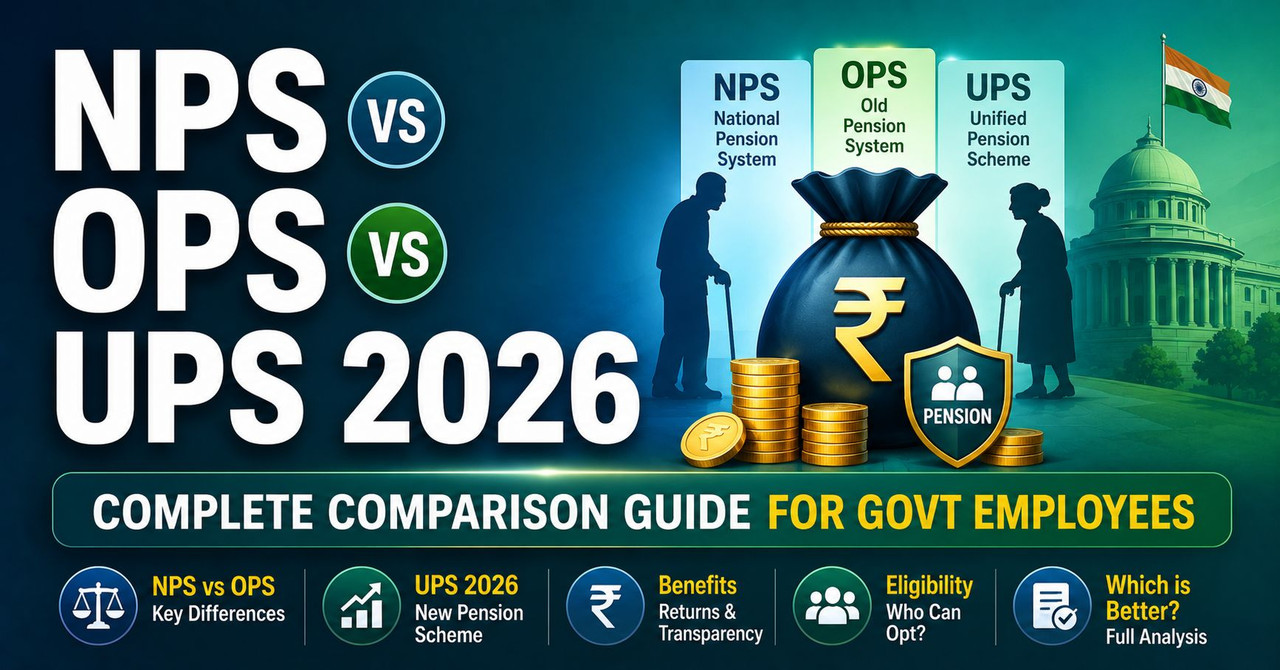
NPS vs OPS vs UPS — Quick Comparison
| Feature | OPS | NPS | UPS |
|---|---|---|---|
| Employee Contribution | None | Yes (~10% of basic+DA) | Yes |
| Pension Type | Defined benefit (fixed) | Market-linked (variable) | Assured (defined, funded) |
| Typical Payout | 50% of last drawn basic+DA | Depends on corpus/annuity performance | ~50% of average last 12 months' basic pay (with 25+ years service) |
| Inflation Protection | Yes (DA-linked) | No fixed inflation protection | Yes (DA-indexed) |
| Fiscal Sustainability (Govt. view) | Considered less sustainable long-term | More sustainable | Balances both considerations |
| Applicable To | Employees who joined before relevant cut-off | Employees who joined after cut-off (most states) | Central govt. employees under NPS, as an opt-in choice |
What This Means for Government Job Aspirants
If you're preparing for a government job, your applicable pension scheme will generally depend on the specific recruiting body (central vs. a specific state) and its current policy at the time you join — since state-level policy has shown it can change (as seen with the states that reverted to OPS), staying informed about your specific target employer's current pension framework, rather than relying on generalised assumptions, is the most reliable approach.
Get Instant Government Job Alerts
Never miss a notification, admit card, or result. Join our free channels for daily sarkari naukri updates delivered straight to your phone:
- 💬 WhatsApp Channel: Join Now
- 📢 Telegram Channel: Join @govtjobsiojobs


Leave a Reply
Be the first to comment.