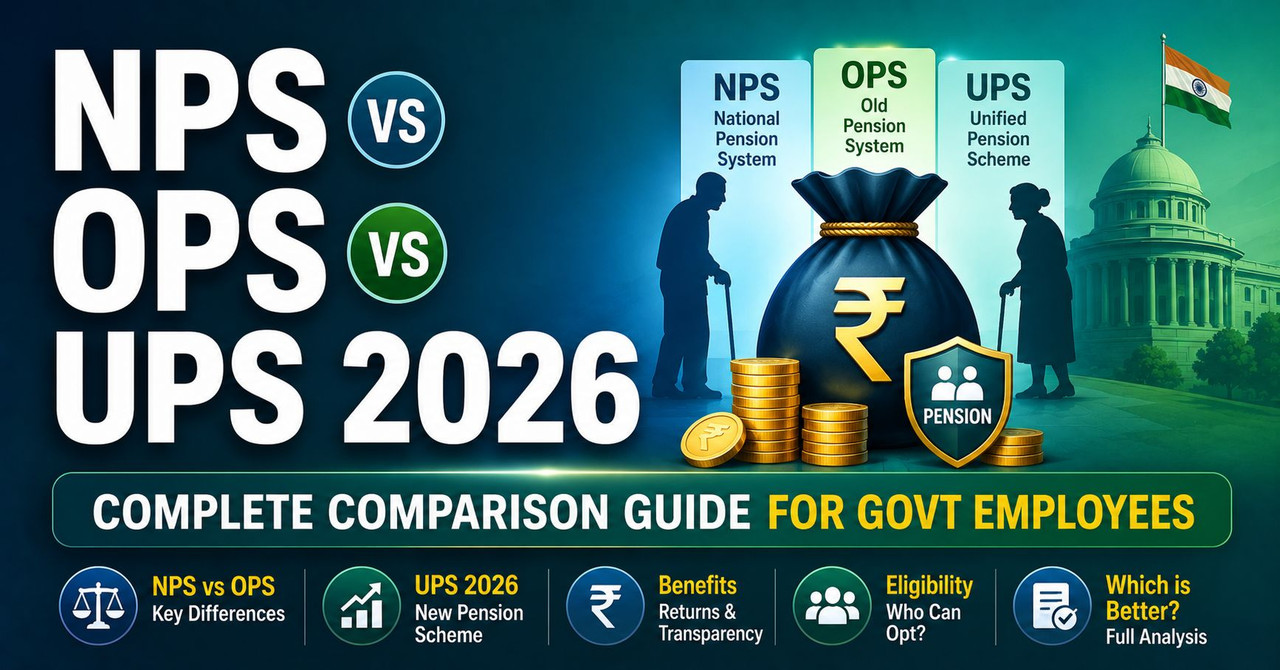
NPS vs OPS vs UPS — Which Pension Scheme is Best in 2026?
If you're a government employee or planning to join government service, understanding pension schemes is CRITICAL for your retirement planning. India currently has three pension systems for government employees:
- OPS (Old Pension Scheme) — For employees appointed before 2004
- NPS (National Pension System) — For employees appointed on or after 1 January 2004
- UPS (Unified Pension Scheme) — New hybrid scheme announced in 2024, effective from 1 April 2025
This complete guide compares all three, helps you understand which one applies to you, and estimates your retirement corpus.
Quick Comparison Table
| Feature | OPS | NPS | UPS |
|---|---|---|---|
| Type | Defined Benefit | Defined Contribution | Hybrid (Defined Benefit + Contribution) |
| Employee Contribution | Nil | 10% of Basic + DA | 10% of Basic + DA |
| Government Contribution | 100% (paid at retirement) | 14% of Basic + DA | 18.5% of Basic + DA |
| Pension Amount | 50% of last drawn salary | Market-linked (variable) | 50% of last 12-month avg pay (guaranteed) |
| Family Pension | 30% of last salary | Depends on annuity | 60% of employee's pension |
| Minimum Pension | Half of last basic + DA | No guarantee | ₹10,000/month |
| DA Adjustment | Yes (biannual) | Depends on annuity | Yes (biannual) |
| Lump Sum at Retirement | Gratuity + Commuted Pension | 60% of corpus (max 60%) | Lump sum + 60% pension |
| Tax Benefits | Fully taxable | Section 80C, 80CCD | Section 80C, 80CCD (expected) |
| Applicable to | Pre-2004 recruits | 2004-2025 recruits | Post-April 2025 (optional) |
1. Old Pension Scheme (OPS) — The Gold Standard
OPS was the default pension system in India until 2003. Under OPS:
Key Features:
- Government pays 100% pension — no employee contribution
- Guaranteed 50% of last drawn basic salary as monthly pension
- Full DA (Dearness Relief) adjustment twice a year
- Family pension continues after employee's death (30% of last salary)
- Free medical benefits (CGHS) continue post-retirement
- Full gratuity (16.5 × last basic × years of service, capped at ₹20 lakh)
Example — OPS Pension Calculation:
If your last basic pay is ₹1,20,000 and you served 33 years:
- Monthly pension = 50% of ₹1,20,000 = ₹60,000/month
- Plus DA (currently 55%) = ₹33,000
- Total pension = ₹93,000/month
- Plus commuted pension: ₹22-25 lakh (one-time)
- Plus gratuity: ₹20 lakh (one-time)
Calculate OPS pension: OPS Pension Calculator →
Who's Eligible for OPS:
- Central government employees appointed BEFORE 1 January 2004
- State employees appointed before OPS was discontinued in respective state
- Some state governments (Rajasthan, Chhattisgarh, Jharkhand, Punjab, Himachal Pradesh) have RESTORED OPS for employees appointed after 2004
2. National Pension System (NPS) — Market-Linked
NPS replaced OPS from 1 January 2004 for central government employees. It's a defined contribution scheme.
Key Features:
- Employee contributes 10% of Basic + DA every month
- Government contributes 14% of Basic + DA (increased from 10% in 2019)
- Total contribution goes to a Pension Fund Manager
- Investment split: 15% Equity, 85% Debt (auto choice) — or your custom choice
- At retirement: 40% of corpus must be used to buy annuity (monthly pension)
- 60% of corpus can be withdrawn as lump sum
- Returns depend on market performance (typically 9-11% CAGR historically)
Example — NPS Corpus Calculation:
Assume you join govt service at age 25 with basic pay ₹25,000. Retirement at 60 (35 years). Annual salary increase of 8%:
- Total contribution over 35 years: ~₹75-80 lakh
- Corpus at retirement (10% return): ₹2.5-3 crore
- Lump sum at retirement (60%): ~₹1.5-1.8 crore
- Annuity purchase (40%): ~₹1-1.2 crore
- Monthly pension from annuity: ~₹50,000-60,000/month
Calculate your NPS corpus: NPS Calculator →
Tax Benefits under NPS:
- Section 80CCD(1): Deduction up to 10% of salary (within ₹1.5 lakh limit under 80C)
- Section 80CCD(1B): Additional ₹50,000 deduction
- Section 80CCD(2): Employer's contribution (14%) fully deductible
- At withdrawal: 60% lump sum is TAX-FREE, 40% annuity is taxable
3. Unified Pension Scheme (UPS) — The New Hybrid
UPS was announced by the Central Government in August 2024 and is effective from 1 April 2025. It combines OPS's guaranteed benefits with NPS's contribution model.
Key Features:
- Employee contribution: 10% of Basic + DA (same as NPS)
- Government contribution: 18.5% of Basic + DA (higher than NPS's 14%)
- Assured pension: 50% of average basic pay of last 12 months
- Minimum pension: ₹10,000/month (guaranteed) for employees with 10+ years of service
- Full DA adjustment on pension (biannual, like OPS)
- Family pension: 60% of employee's pension amount
- Gratuity + Lump sum: In addition to pension
- Retirement lump sum: 1/10th of monthly pay for every completed 6 months of service (approximately 5x last drawn pay)
Example — UPS Pension:
If your average of last 12 months basic pay is ₹1,00,000 and service is 25 years:
- Monthly pension = 50% of ₹1,00,000 = ₹50,000/month
- Plus DA (55%) = ₹27,500
- Total pension = ₹77,500/month
- Plus gratuity: ~₹20 lakh
- Plus lump sum: ~₹5 lakh (5x last basic)
Compare UPS vs NPS: UPS vs NPS Calculator →
Who's Eligible for UPS:
- All Central government employees currently under NPS can OPT for UPS
- New employees joining after 1 April 2025 (default under NPS but can switch)
- Existing NPS retirees can also switch (with certain conditions)
Deadline for Existing Employees to Choose: Government has provided a specific window — check current PFRDA notifications.
OPS vs NPS vs UPS — Which is Best?
Scenario 1: You're a Pre-2004 Central Government Employee
You're on OPS. No decision needed. Enjoy your guaranteed pension.
Scenario 2: You're Currently Under NPS (Joined between 2004-2025)
You have a CHOICE. Consider switching to UPS if:
- You want guaranteed pension amount (peace of mind)
- You don't want to worry about market fluctuations
- You have more than 10 years of remaining service
- You value predictable retirement income
Stay in NPS if:
- You believe in higher long-term returns from equity markets
- You have less than 10 years to retirement (UPS may not be significantly better)
- You want to leave a corpus (60% lump sum) for family
Scenario 3: You're Joining Government Service Now
Your default is NPS, but you can opt for UPS. My recommendation:
Choose UPS if:
- You're risk-averse
- You want guaranteed pension amount
- You value job security AND retirement security equally
Stay with NPS if:
- You want to build a larger corpus (60% lump sum)
- You're okay with market risk for potentially higher returns
- You want flexibility in investment choices
Detailed Calculation — 35-Year Career
Assume you join govt at 25 with basic pay ₹25,000. Retire at 60. Career average basic pay: ₹80,000. Last drawn basic: ₹1,50,000.
Under OPS (Pre-2004 employees):
- Monthly pension: ₹75,000 (50% of last drawn)
- Plus DA: ₹41,250
- Total pension: ₹1,16,250/month
- Commuted pension: ₹27 lakh
- Gratuity: ₹20 lakh
- Total post-retirement wealth: ₹47 lakh + ₹1.16L/month for life
Under NPS:
- Corpus at 60: ~₹2.8 crore
- Lump sum (60%): ₹1.68 crore
- Annuity purchase (40%): ₹1.12 crore
- Monthly pension: ~₹56,000/month (@ 6% annuity rate)
- Plus DA on pension: Depends on annuity type
- Gratuity: ₹20 lakh
- Total post-retirement wealth: ₹1.88 crore lump sum + ₹56K/month
Under UPS:
- Monthly pension: ₹75,000 (50% of last 12-month avg = ₹1,50,000)
- Plus DA: ₹41,250
- Total pension: ₹1,16,250/month (same as OPS!)
- Lump sum: ~₹7.5 lakh
- Gratuity: ₹20 lakh
- Total post-retirement wealth: ₹27 lakh + ₹1.16L/month for life
Verdict:
- OPS is best (but only available to pre-2004 employees or few state employees)
- UPS is 2nd best — guaranteed pension close to OPS levels
- NPS is highest lump sum but variable monthly pension
Common Questions
Q1: Can I switch between NPS and UPS multiple times? No. Switching is a one-time decision within the notified window.
Q2: What happens to my existing NPS corpus if I switch to UPS? Your accumulated NPS corpus will be transferred to your UPS account.
Q3: Is UPS available for state government employees? UPS is currently for Central government employees. States can adopt it — some states are considering.
Q4: Which is better for tax savings? NPS offers the best tax benefits — ₹2 lakh deduction (₹1.5L under 80C + ₹50K under 80CCD-1B).
Q5: Can I withdraw from NPS before retirement? Partial withdrawal (max 25% of employee contribution) allowed after 3 years for specific purposes (education, marriage, medical, home).
Useful Retirement Planning Tools
- OPS Pension Calculator — Estimate OPS pension
- NPS Calculator — Estimate NPS corpus
- UPS vs NPS Calculator — Direct comparison
- Gratuity Calculator — Calculate gratuity
- Leave Encashment Calculator — Estimate leave encashment
- Commuted Pension Calculator — Calculate lump sum
- 7th Pay Commission Calculator — Current salary
- Retirement Benefits Calculator — Complete package
Final Advice
For existing central government employees currently under NPS: Consider carefully — do the math for both NPS and UPS based on YOUR specific salary and years of service. Use the UPS vs NPS Calculator with your actual numbers before deciding.
For new government employees: UPS provides peace of mind with guaranteed 50% pension. NPS could provide higher lump sum if markets perform well. Choose based on your risk appetite.
For state government employees: Watch your state's decision on OPS restoration or UPS adoption. Rajasthan, Chhattisgarh, Jharkhand, Punjab, and HP have already restored OPS. Others may follow.
Your retirement is 20-35 years away — but the decision you make today about pension scheme will impact your family for the next 40-50 years. Choose wisely.
Browse All Latest Government Jobs →
Explore All 39 Free Tools →](/tools)


Leave a Reply
Be the first to comment.