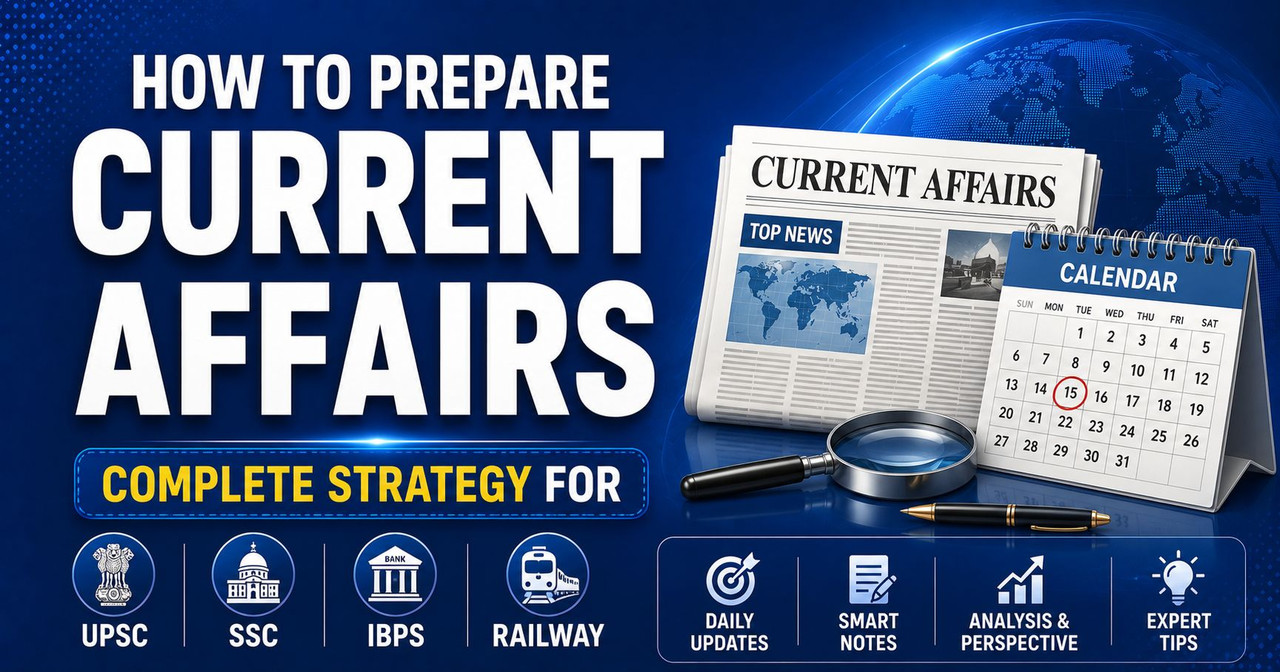
How to Master Current Affairs for Government Exams — A Complete Strategy Guide
Current Affairs is the make-or-break section in every government exam. Whether it's UPSC CSE, SSC CGL, IBPS PO, Railway NTPC, or State PSC — 20-40% of your total marks depend on how well you know what's happening in India and the world.
Yet, most aspirants struggle with Current Affairs. They read newspapers randomly, forget everything in a week, and panic before exams. This complete guide gives you a proven system — used by top rankers — to master current affairs efficiently.
Why Current Affairs is So Important
Marks Distribution in Major Exams:
| Exam | Current Affairs Weightage |
|---|---|
| UPSC Prelims | 40-50 questions out of 100 (50%) |
| UPSC Mains GS | 60-70% content is current affairs based |
| SSC CGL | 25 questions in Tier-1 (25% of 100) |
| IBPS PO Mains | 40 questions out of 155 (26%) |
| SBI PO Mains | 40 questions (Banking + Current Affairs) |
| Railway NTPC | 40 questions in CBT-1 |
| State PSC | 30-40% weightage |
Current Affairs is the ONLY section where good preparation guarantees marks — Reasoning and Quant depend on skills you build over time, but Current Affairs is pure memorization + understanding.
The 4-Layer Current Affairs System
Master current affairs by treating it as 4 distinct layers:
Layer 1: Daily News (Foundation)
Source: 1 English newspaper (The Hindu or Indian Express) OR 1 Hindi newspaper (Dainik Jagran/Hindustan) Time: 45-60 minutes/day Focus: Editorial, National, International, Economy, Science, Sports
Layer 2: Weekly Compilation (Consolidation)
Source: Weekly PDFs from Vision IAS, Insights, Drishti IAS, GK Today Time: 2 hours/weekend Focus: Categorized notes — Polity, Economy, IR, Science, Environment, Sports
Layer 3: Monthly Magazine (Deep Understanding)
Source: Pratiyogita Darpan, Vision IAS Monthly Magazine, GK Today Monthly, Kurukshetra, Yojana Time: 3-4 hours/month Focus: In-depth analysis of major events, government schemes, editorial insights
Layer 4: Yearly Compilation (Revision Before Exam)
Source: Manorama Yearbook, Lucent GK, Arihant Yearbook Time: 20-30 hours across 2 months before exam Focus: Complete revision of the year's events
Best Sources for Current Affairs
Newspapers (Choose ONE)
1. The Hindu
- Best for: UPSC, Bank Officer, Analytical exams
- Strengths: Editorial quality, opinion pieces, foreign coverage
- Weakness: Dense, time-consuming
2. Indian Express
- Best for: UPSC, SSC, IBPS
- Strengths: Balanced coverage, "Explained" section
- Weakness: Slightly less depth than The Hindu
3. Dainik Jagran / Hindustan (Hindi)
- Best for: SSC, IBPS, Railway (Hindi Medium)
- Strengths: Easy language, focused content
Tip: Read only these sections — Front Page, National, International, Editorial, Economy, Science & Tech, Sports. Skip: City news, obituaries, entertainment (except awards).
Monthly Magazines
Free Options:
- Yojana (Government of India) — Economic issues
- Kurukshetra (Government of India) — Rural development
- Pratiyogita Darpan (Hindi/English) — General current affairs
Paid Options:
- Vision IAS Monthly Magazine (Best for UPSC)
- GK Today Monthly
- Arihant Current Affairs Monthly
Digital Sources
Free Websites:
- AIR (All India Radio) News: newsonair.gov.in — Reliable government-verified news
- PIB India: pib.gov.in — Government announcements, cabinet decisions
- PRS India: prsindia.org — Bills, Acts, Parliamentary sessions
- Vision IAS: visionias.in — Daily and weekly current affairs
- Insights IAS: insightsonindia.com — UPSC-focused analysis
YouTube Channels:
- StudyIQ — Fast-paced daily current affairs
- Vision IAS — Detailed analysis
- Aaj Ki Baat with Rajat Sharma — Hindi news wrap
- The Wire — Investigative reporting
- All India Radio — Official news
Apps:
- PIB Delhi (Official government)
- Vision IAS
- BYJU'S Current Affairs
- Testbook Current Affairs — Great for banking exams
The 45-Minute Daily Routine
Morning (30 minutes) — With coffee/breakfast:
- 10 min: Read newspaper headlines and skim
- 15 min: Focus on Editorial + Explained sections
- 5 min: Make notes of important terms/schemes/personalities
Evening (15 minutes) — After work/study:
- 10 min: Watch a summary video (StudyIQ, PIB) OR read Vision IAS Daily Analysis
- 5 min: Test yourself — recall today's key events without notes
Weekly (2 hours on Sunday):
- Read Weekly Compilation PDF
- Update your notebook with categorized notes
- Take a mini current affairs quiz
What to Focus On (By Exam)
For UPSC (CSE, CDS, NDA)
- Focus: Government schemes, international relations, economy, environment
- Time period: 18 months for Prelims, 12 months for Mains
- Special focus: India's foreign policy, defense deals, Supreme Court judgments, environment reports (Global Warming, COP conferences)
For SSC (CGL, CHSL, MTS)
- Focus: Sports (very high weightage — Olympics, IPL, Cricket, awards), Government schemes, appointments, books & authors
- Time period: Last 6-12 months
- Special focus: Sports championships, Padma Awards, Nobel Prize, Booker Prize
For IBPS/SBI Bank Exams
- Focus: Banking sector news (RBI policies, mergers, new products), Financial current affairs, Government schemes (Jan Dhan, Mudra, PMFBY), Economy
- Time period: Last 6 months
- Special focus: RBI announcements, GDP data, inflation, banking mergers, digital banking initiatives
For Railway RRB
- Focus: Sports, Awards, Books, Science & Tech, Static GK mix
- Time period: Last 12 months
- Special focus: Railway-specific news, defence updates
For State PSC Exams
- Focus: 60% state-specific + 40% national
- State sources: State government website, state newspaper (e.g., Rajasthan Patrika for RPSC)
- Special focus: State budget, CM announcements, state schemes, local awards
The Notes-Making System
Digital Method (Recommended):
Use Notion, Evernote, or Google Docs with categorization:
Categories to maintain:
- Government Schemes (with launch date, ministry, objective)
- International Relations (bilateral agreements, visits, joint statements)
- Economy & Banking (RBI decisions, GDP, inflation)
- Environment (climate agreements, reports, initiatives)
- Science & Technology (space missions, defence, health)
- Sports (winners, tournaments, records)
- Awards & Honours (Padma, Nobel, Bharat Ratna, national)
- Books & Authors
- Appointments (Supreme Court, RBI Governor, Chief of Army, etc.)
- Deaths & Obituaries (important personalities)
- Days & Themes (International Days, National Days)
Physical Notebook Method:
Maintain a small notebook (A5 size). Divide into sections above. Write ONE-LINE notes daily.
Example: "PM launched PM Vishwakarma Yojana on 17 September 2023 (Vishwakarma Jayanti). Aims to support artisans and craftspeople. Provides ₹15,000 grant + loan + skill training."
The Revision Formula
Current Affairs revision follows the 1-7-30-90 rule:
- Day 1: Read and note down
- Day 7: Revise the week's compilation
- Day 30: Revise the month's magazine
- Day 90: Revise the quarter's compilation
- Exam month: Read yearly compilation (last 12 months only)
Repeated exposure ensures long-term retention.
What NOT to Do
1. Don't read multiple newspapers. One is enough. Reading 3 wastes time.
2. Don't try to remember EVERYTHING. Focus on categories mentioned above. Skip local news, minor events.
3. Don't skip revision. Reading without revision is 30% effective. Revision is more important than initial reading.
4. Don't consume news 3 hours daily. 45-60 minutes is enough. More becomes counterproductive.
5. Don't start 6 months before exam. Start 12-18 months before. UPSC needs 18 months coverage.
6. Don't rely only on YouTube. Videos are good for summary, but read to remember.
7. Don't ignore Static GK. Current Affairs + Static GK together form the General Awareness section.
Free Resources Compilation
Newspapers: epaper.thehindu.com (limited free), inshorts.com (news summary)
Free Monthly PDFs: Google search "Vision IAS Monthly Current Affairs May 2026 PDF" — always available for free
Government Sources:
- pib.gov.in (Press Information Bureau)
- newsonair.gov.in (All India Radio)
- rbi.org.in (RBI)
- indiabudget.gov.in (Union Budget)
Free YouTube: StudyIQ, Vision IAS, Testbook Live
Free Test Series: Practice quizzes on Testbook, Adda247 (free daily quiz), Oliveboard (free daily)
Exam-Wise Time Allocation
If exam is 12 months away:
- Daily reading: 45 min
- Weekly revision: 2 hours
- Monthly magazine: 3 hours
- No panic, systematic approach
If exam is 6 months away:
- Daily reading: 60 min
- Weekly revision: 3 hours
- Monthly magazine: 3 hours
- Start weekly mock tests (only GK section)
If exam is 3 months away:
- Daily reading: 60 min
- Weekly revision: 4 hours
- Complete last 12 months in yearly compilation
- Full mock tests every 3 days
If exam is 1 month away:
- Daily reading: 45 min
- Focus on last 6 months
- Yearly compilation revision (2 times)
- Mock tests daily
The Static GK + Current Affairs Combo
Static GK (unchanging facts) + Current Affairs (recent events) together form GA section.
Static GK topics:
- Indian History (Ancient, Medieval, Modern)
- Geography (Physical, Political, Economic)
- Polity (Constitution, Fundamental Rights)
- Economics basics
- General Science (Physics, Chemistry, Biology basics)
Free Static GK Resource: Lucent's General Knowledge (₹350 book, essential for every aspirant)
Common Questions
Q1: I have only 3 months. Can I still cover current affairs? Yes! Read last 6 months yearly compilation + daily current affairs. Skip in-depth reading of monthly magazines.
Q2: Which is better — Hindi or English medium? Choose your comfort language. Content availability is 90% same. English has slight edge in variety.
Q3: How to remember dates and numbers? Make mnemonic devices. Example: PM Kisan gives ₹6,000/year = "Sixty for Kisan" (six thousand for farmer)
Q4: Do I need to read editorial? For UPSC — YES, essential. For SSC/Bank/Railway — SKIM editorials for context, don't memorize.
Q5: How to test my current affairs preparation? Take daily/weekly quizzes. Testbook and Adda247 offer free daily quizzes with 10-15 questions.
Useful Tools
- Age Eligibility Calculator — Check exam eligibility
- Exam Countdown Timer — Track days to your exam
- Cut-off Marks Calculator — Estimate your score
- Photo & Signature Resizer — For exam application
Final Advice
Current affairs is not about "reading more" — it's about "reading smart." A student who reads 1 newspaper for 45 minutes daily + revises weekly + does monthly magazine will beat someone who reads 3 newspapers randomly and never revises.
Consistency > Intensity. 45 minutes daily for 12 months = 273 hours of focused preparation. That's enough to crack any exam.
Start today. Not tomorrow. Not "when I'm free." Today.
Browse All Latest Government Jobs →
Explore All 12 Blog Articles →](/blog)



Leave a Reply
Be the first to comment.