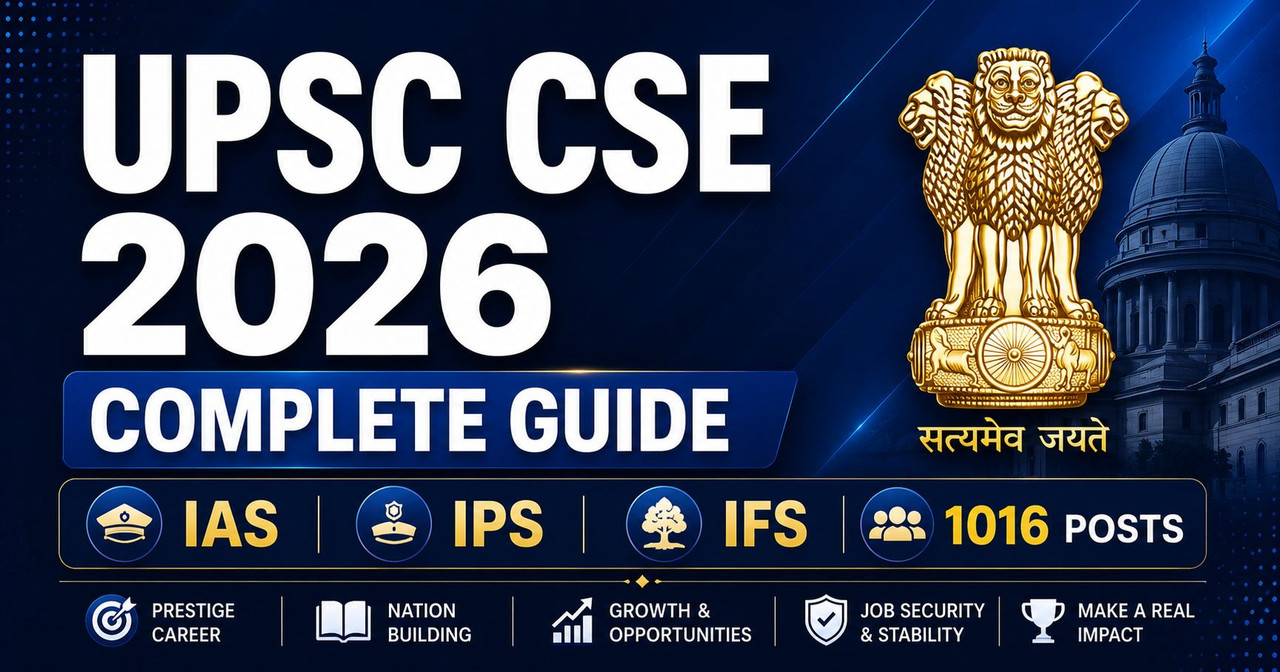
UPSC CSE — India's Most Prestigious Government Exam
The UPSC Civil Services Examination (CSE) is the gateway to India's most powerful administrative posts — IAS, IPS, IFS, IRS, and 20+ other Group A and Group B central services. Every year, over 10 lakh candidates apply, but only about 1,000 make it to the final list. This is India's toughest and most respected exam.
The UPSC CSE 2026 Notification has already been released, with 1,016 vacancies. This complete guide covers everything — from eligibility to preparation strategy.
UPSC CSE — Quick Overview
- Conducting Body: Union Public Service Commission (UPSC)
- Post Types: IAS, IPS, IFS (Indian Foreign Service), IRS (Income Tax & Customs), IAAS, ICAS, IPoS, IRAS, IRPS, ITS, and 14 more services
- Vacancies 2026: 1,016
- Prelims Held: 24 May 2026 (Result declared 15 June 2026 — 13,343 qualified)
- Mains Exam: 21 August 2026 onwards
- Interview: March-April 2027 (tentative)
Services Under UPSC CSE
All India Services (Cream posts)
1. IAS (Indian Administrative Service): The most sought-after post. Head of civil services in states, districts, and central ministries. Starting salary ~₹85,000/month + facilities.
2. IPS (Indian Police Service): Head of police in states. Starts as Assistant Superintendent of Police (ASP), rises to DGP. Salary similar to IAS.
3. IFoS (Indian Forest Service): Manages forests and wildlife. Separate Mains paper on forestry subjects.
Central Civil Services Group A
4. IFS (Indian Foreign Service): Diplomats posted at Indian embassies abroad. Handles India's foreign policy.
5. IRS-IT (Indian Revenue Service - Income Tax): Investigates tax evasion, audits companies.
6. IRS-Customs & Central Excise: Handles customs, GST, excise duties.
7. IAAS (Indian Audit & Accounts Service): Audits central and state government accounts.
8. Indian Postal Service, Railway services, Defence Accounts Service, Trade Service, and 12+ more.
Central Civil Services Group B
9. DANICS, DANIPS, and Pondicherry Civil/Police Services — for Delhi, Andaman & Nicobar, and Puducherry.
Eligibility Criteria
Educational Qualification: Bachelor's degree (Graduation) in any discipline from a recognized university. Final-year students can apply.
Age Limit:
- General: 21-32 years
- OBC: 21-35 years (+3)
- SC/ST: 21-37 years (+5)
- PwBD: 21-42 years (+10)
- Ex-Servicemen: +5 years
Number of Attempts:
- General: 6 attempts
- OBC: 9 attempts
- SC/ST: Unlimited attempts (till age limit)
- PwBD: 9 attempts (Gen/OBC), unlimited (SC/ST)
Nationality: Indian citizen (for IAS, IPS, IFS). Nepal/Bhutan citizens for other services.
Check your eligibility: Age Eligibility Calculator →
Exam Pattern — 3 Stages
Stage 1: Preliminary Examination (Screening)
Paper 1: General Studies (GS)
- 100 questions, 200 marks, 2 hours
- Negative marking: 1/3rd
Paper 2: CSAT (Aptitude Test)
- 80 questions, 200 marks, 2 hours
- Qualifying only (33% required)
- Negative marking: 1/3rd
Only GS-1 score counts for Prelims cut-off.
Stage 2: Mains Examination (Merit)
9 papers, 1750 marks total (only 7 count for merit):
| Paper | Subject | Marks | Nature |
|---|---|---|---|
| Paper A | Indian Language | 300 | Qualifying (25% required) |
| Paper B | English | 300 | Qualifying (25% required) |
| Paper 1 | Essay | 250 | Merit |
| Paper 2 | GS-1 (History, Geography, Society) | 250 | Merit |
| Paper 3 | GS-2 (Polity, Governance, IR) | 250 | Merit |
| Paper 4 | GS-3 (Economy, Environment, Sci-Tech) | 250 | Merit |
| Paper 5 | GS-4 (Ethics, Integrity, Aptitude) | 250 | Merit |
| Paper 6 | Optional Subject Paper 1 | 250 | Merit |
| Paper 7 | Optional Subject Paper 2 | 250 | Merit |
Total Merit Marks: 1750 (GS 1-4 = 1000 + Essay 250 + Optional 500)
Stage 3: Interview / Personality Test
- 275 marks
- 30-45 minute conversation with UPSC Board members
- Tests personality, general awareness, and clarity of thought
Final Merit: Mains (1750) + Interview (275) = 2025 marks
Salary of IAS/IPS/IFS Officers
IAS/IPS/IFS Entry Level (Junior Time Scale):
- Basic Pay: ₹56,100 (Pay Level 10)
- DA (55%): ₹30,855
- HRA (Metro 27%): ₹15,147
- Gross: ~₹1,05,000/month
- In-hand: ~₹85,000-₹92,000/month
Additional Perks:
- Government bungalow in prime locations
- Government car with driver
- Free travel (LTC, official)
- Free medical (CGHS)
- Domestic help allowance
- Pension (NPS)
Career Progression:
- Senior Time Scale (4 years): ₹67,700 (Level 11)
- Junior Administrative Grade (9 years): ₹78,800 (Level 12)
- Selection Grade (13 years): ₹1,18,500 (Level 13)
- Super Time Scale (16 years): ₹1,44,200 (Level 14)
- Above Super Time Scale (25 years): ₹1,82,200 (Level 15)
- HAG+ (30 years): ₹2,05,400 (Level 16)
- Apex Scale (Cabinet Secretary): ₹2,50,000 (Level 17)
Calculate your future salary: 7th Pay Commission Calculator →
Application Fee
- Prelims: ₹100 (General/OBC), Free (SC/ST/PwBD/Female)
- Mains: ₹200 (General/OBC), Free (SC/ST/PwBD/Female)
GS Syllabus Highlights
General Studies Paper 1 (Prelims + Mains)
- History: Ancient (Harappan to Gupta), Medieval (Delhi Sultanate to Mughals), Modern (1757-1947), Post-Independence
- Geography: Physical, Indian, World, Economic Geography, Environment
- Polity: Constitution, Fundamental Rights, DPSP, Parliament, Judiciary, Local Government
- Economics: Basic concepts, Indian Economy, Budget, Banking, Agriculture
- Environment: Climate Change, Biodiversity, Conservation
- Current Affairs: Last 12 months for Prelims, 18 months for Mains
- Science & Technology: Space, IT, Biotech, Nuclear, Defence
CSAT (Prelims Paper 2)
- Reading Comprehension (60% weightage)
- Logical Reasoning
- Basic Numeracy (Class 10 level)
- Data Interpretation
Optional Subjects (Mains)
Choose from 48 optional subjects. Popular ones:
- PSIR (Political Science & International Relations) — Highest opt rate
- Sociology — Scoring, less content
- Geography — Overlap with GS
- History — Overlap with GS
- Public Administration — Direct relevance
- Anthropology — High scoring
- Literature (Any Language) — Native speakers advantage
Strategy: Choose based on: interest + graduation background + coaching availability + scoring history.
1-Year Preparation Strategy
Months 1-3: Foundation Complete NCERT (Class 6-12) for History, Geography, Polity, Economics. Read Laxmikanth (Polity), Bipin Chandra (History), NCERT Geography.
Months 4-6: Standard Books + Newspaper Read Daily The Hindu / Indian Express. Standard books — Spectrum (Modern History), Certificate (Geography), Sanjeev Verma (Economy). Start optional subject.
Months 7-9: Answer Writing + Mocks Join test series. Practice Mains answer writing. Weekly essay writing. Complete optional syllabus.
Months 10-12: Revision + Test Series Full-length Prelims + Mains mocks. Revise GS 3 times. Optional revision. Interview preparation (if time permits).
Previous Year Prelims Cut-off (GS Paper 1)
| Category | 2025 | 2024 | 2023 |
|---|---|---|---|
| General | 87.5 | 92.5 | 88.2 |
| OBC | 84.0 | 89.1 | 87.5 |
| SC | 74.0 | 78.0 | 75.5 |
| ST | 74.0 | 79.5 | 76.0 |
| EWS | 82.0 | 83.5 | 82.8 |
Estimate your score: Cut-off Marks Calculator →
UPSC Success Rate — The Reality
- Total Applicants: ~11-12 lakh
- Appeared in Prelims: ~5.5 lakh
- Qualified for Mains: ~13,000
- Qualified for Interview: ~2,500-2,800
- Final Selection: ~1,000
- Success Rate: 0.1% (1 in 1,000 applicants)
Common Mistakes to Avoid
1. Ignoring NCERTs: All GS papers are based on NCERT foundations. Skip these, and you fail Prelims.
2. Too Many Books: Reading 20 books once is worse than reading 5 books 5 times. Stick to standard sources.
3. Neglecting Current Affairs: Prelims includes 40-50 current affairs questions. Mains needs 12-18 months of current events.
4. Postponing Optional: Start optional in Month 4 latest. Optional carries 500 marks — critical for final rank.
5. No Answer Writing Practice: Mains is about writing 150+ words per question in 7-8 minutes. Practice from Day 1.
Useful Tools for UPSC Preparation
- Age Eligibility Calculator — Check age and attempts
- Photo & Signature Resizer — UPSC photo specs (3×3.5cm, 40-300 KB)
- 7th Pay Commission Calculator — Calculate IAS/IPS salary
- Cut-off Marks Calculator — Score estimation
- NPS Calculator — Calculate your pension
Final Advice
UPSC CSE is a marathon, not a sprint. It takes 1-2 years of dedicated preparation for most successful candidates. But the reward — becoming an IAS/IPS/IFS officer, serving the nation, and having lifelong prestige — is unmatched.
Key mantras:
- Consistency > Intensity — Study 6-8 hours daily for 1 year
- Understand > Memorize — UPSC tests understanding, not memorization
- Revise > New Content — 3 revisions of standard books beat 1 reading of 20 books
- Newspaper > Coaching — Daily newspaper is more important than any coaching
Browse All Central Government Jobs →
Check the UPSC CSE Prelims Result 2026 →](/job/upsc-cse-prelims-result-2026)



Leave a Reply
Be the first to comment.