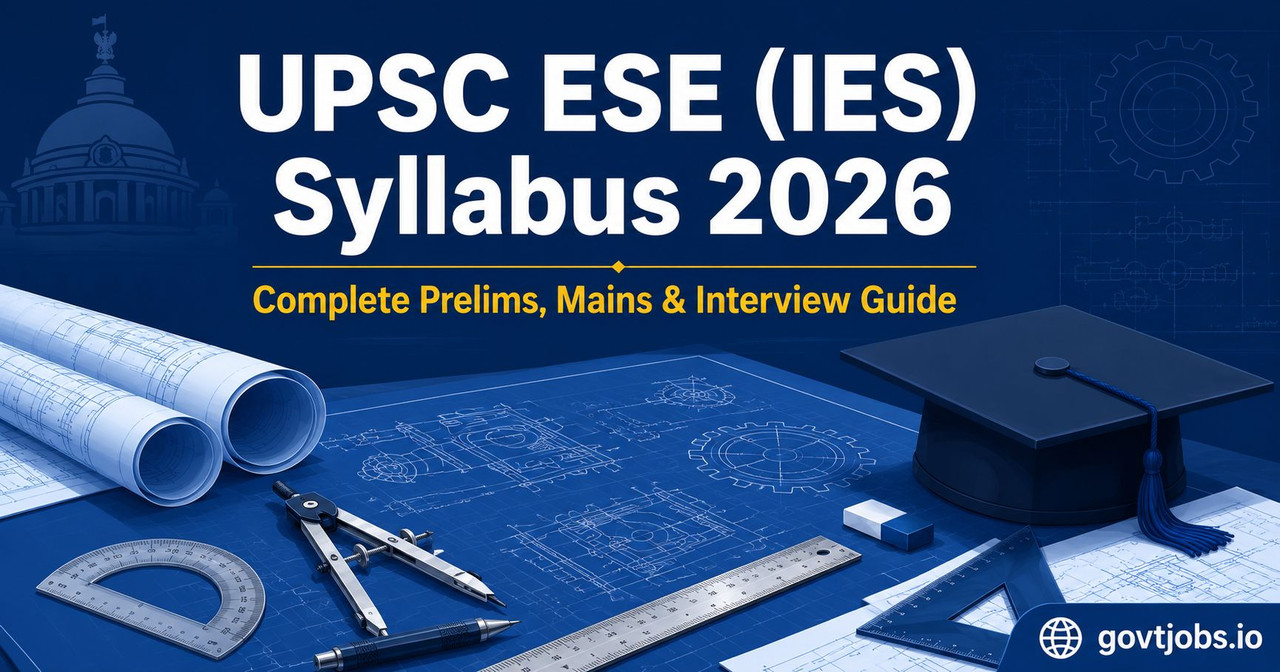
The UPSC Engineering Services Examination (ESE), commonly known as IES, is one of the most sought-after exams for engineering graduates aiming for a career in premier government engineering services like Indian Railways, Central Engineering Service, Indian Defence Service of Engineers, and more. The exam is conducted in three stages — Preliminary Examination, Main Examination, and Personality Test — and covers four engineering streams: Civil Engineering, Mechanical Engineering, Electrical Engineering, and Electronics & Telecommunication Engineering.
UPSC ESE Exam Pattern Overview
| Stage | Papers | Marks | Duration |
|---|---|---|---|
| Preliminary | Paper I (General Studies & Engineering Aptitude) | 200 | 2 hours |
| Preliminary | Paper II (Engineering Discipline-specific) | 300 | 3 hours |
| Mains | Paper I & Paper II (Discipline-specific, conventional) | 300 each | 3 hours each |
| Personality Test | Interview | 200 | — |
Only candidates who clear the Preliminary stage are called for the Mains examination, and only those who clear both written stages proceed to the Personality Test.
Preliminary Examination Syllabus
Paper I — General Studies and Engineering Aptitude
This paper is common to all four engineering streams and covers:
- Current issues of national and international importance relating to social, economic, and industrial development
- Engineering Aptitude covering Logical Reasoning and Analytical Ability
- Engineering Mathematics and Numerical Analysis
- General Principles of Design, Drawing, and Importance of Safety
- Standards and Quality Practices in Production, Construction, Maintenance, and Testing
- Basics of Energy and Environment — conservation, environmental pollution, degradation, and climate change
- Basics of Project Management
- Basics of Material Science and Engineering
- Information and Communication Technologies (ICT) based tools and their applications in Engineering
- Ethics and values in the Engineering profession
Paper II — Discipline-Specific
Civil Engineering: Building Materials, Estimation, Costing and Valuation, Surveying, Soil Mechanics, Structural Analysis, Concrete Structures, Steel Structures, Design of Structures, Construction Practice, Planning and Management, Water Resources Engineering, Environmental Engineering, Transportation Engineering, and Geo-technical Engineering.
Mechanical Engineering: Fluid Mechanics, Thermodynamics, IC Engines, Refrigeration and Air Conditioning, Turbo Machinery, Power Plant Engineering, Renewable Sources of Energy, Engineering Mechanics, Strength of Materials, Theory of Machines, Machine Design, Engineering Materials, Manufacturing Analysis, Production, Industrial Engineering, Operations Research, Mechatronics, and Robotics.
Electrical Engineering: Engineering Mathematics, Electrical Materials, Electric Circuits and Fields, Electrical and Electronic Measurements, Computer Fundamentals, Basic Electronics Engineering, Analog and Digital Electronics, Systems and Signal Processing, Control Systems, Electrical Machines, Power Systems, Power Electronics and Drives.
Electronics & Telecommunication Engineering: Basic Electronics Engineering, Basic Electrical Engineering, Materials Science, Electronic Devices, Analog and Digital Circuits, Analog and Digital Communication Systems, Control Systems, Computer Organization and Architecture, Electromagnetics, Advanced Electronics Topics, Advanced Communication Topics, and Advanced Computer Engineering.
Mains Examination Syllabus
The Mains examination consists of two conventional (descriptive) papers for the candidate's chosen engineering discipline, testing deeper technical and application-based understanding of the same broad topics covered in Paper II of the Preliminary stage, but at a significantly more advanced and analytical level. Answers require detailed technical explanations, numerical problem-solving, and design-based responses rather than objective selection.
Personality Test (Interview)
Candidates who clear both the Preliminary and Mains written stages are called for a Personality Test carrying 200 marks. The interview assesses the candidate's suitability for a career in engineering services through an evaluation of mental alertness, clarity of expression, balance of judgment, integrity, and depth of interest in the candidate's chosen field of engineering.
Preparation Tips
- Start with NCERT-level engineering fundamentals before moving to advanced reference books for your discipline
- Practice previous years' question papers to understand the exact difficulty level and question pattern
- For Paper I, stay updated on current affairs related to infrastructure, energy, and technology policy
- For Mains, practice writing detailed, structured answers within time limits since presentation matters as much as content
Get Instant Government Job Alerts
Never miss a notification, admit card, or result. Join our free channels for daily sarkari naukri updates delivered straight to your phone:
- 💬 WhatsApp Channel: Join Now
- 📢 Telegram Channel: Join @govtjobsiojobs

Leave a Reply
Be the first to comment.